Planning your first trip to South Korea can feel exciting, but also a little overwhelming.
There are palaces, food markets, mountain views, K-pop spots, skincare shops, beach cities, historic temples, fast trains, local apps, transportation cards, and endless neighborhoods to explore. If you only have one week in Korea, the key is not to see everything. The key is to choose a simple route that gives you the best first impression of the country.
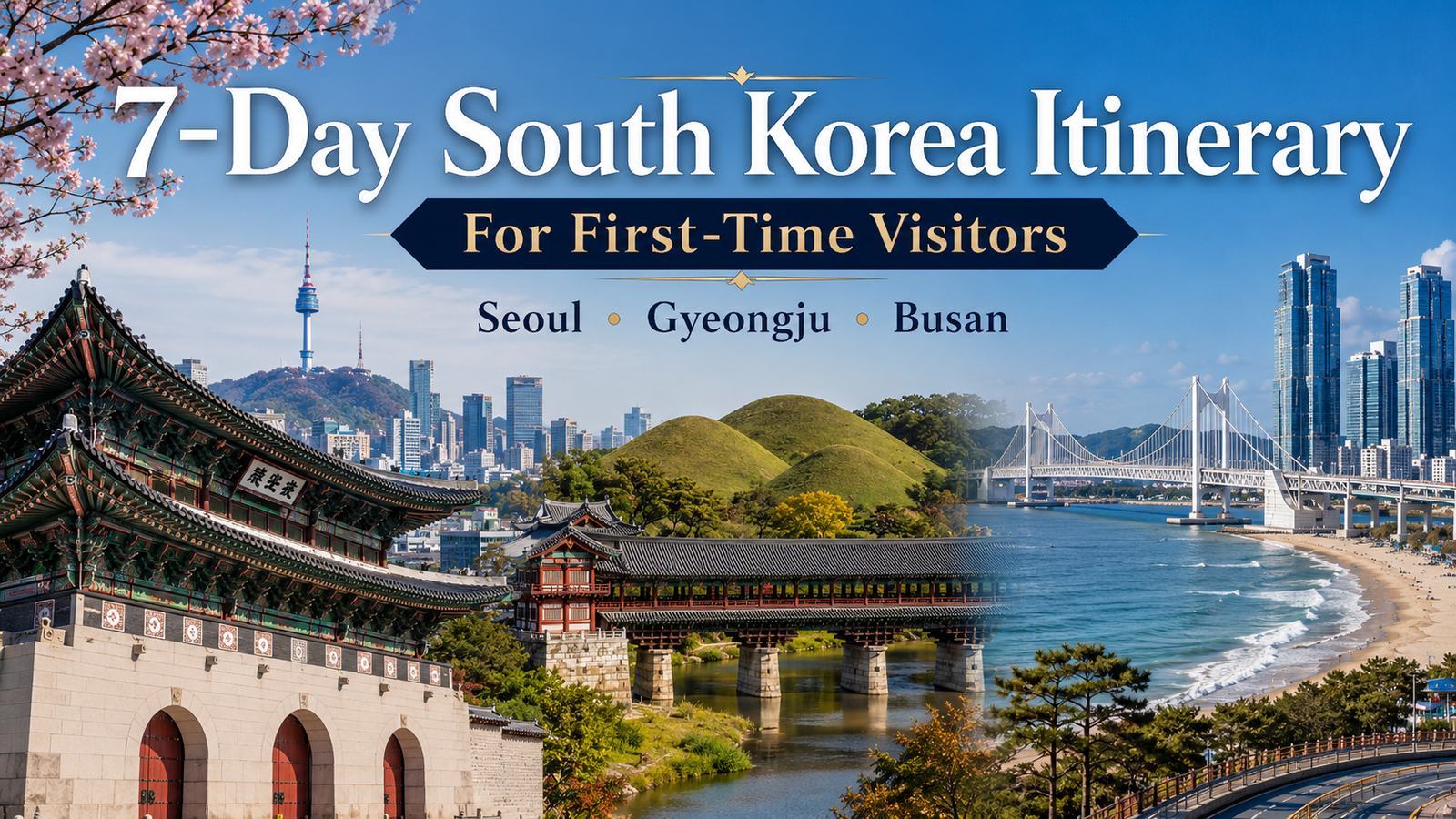
This 7-day South Korea itinerary is designed for first-time visitors who want to experience three different sides of Korea:
Seoul, the modern capital full of palaces, shopping, food, cafés, K-beauty, and nightlife.
Gyeongju, Korea’s historic city where you can see royal tombs, hanok streets, ancient temples, and UNESCO World Heritage sites.
Busan, Korea’s coastal city known for beaches, seafood markets, colorful villages, and a more relaxed atmosphere.
This route keeps the trip realistic. You will not change hotels every night, and you will not try to squeeze too many cities into one week. Instead, you will spend enough time in each place to enjoy it properly.
Is 7 Days Enough for South Korea?
Seven days is enough for a first taste of South Korea, but it is not enough to see the entire country.
For a first-time visitor, the best strategy is to focus on a clear route instead of adding too many destinations. Korea has excellent public transportation, and the train network makes it possible to travel between major cities efficiently. However, every hotel change, train ride, airport transfer, and new city still takes time and energy.
For most first-time visitors, the best 7-day route is:
Seoul → Gyeongju → Busan
This gives you a strong mix of modern Korea, traditional Korea, and coastal Korea.
If you prefer a slower trip, you can also stay in Seoul for the full week and add one or two day trips. I will include a Seoul-only alternative later in this guide.
Best 7-Day South Korea Route for First-Time Visitors
Here is the simple version of this itinerary.
| Day | Base | Main Plan | Overnight |
|---|---|---|---|
| Day 1 | Seoul | Arrival, Myeongdong, N Seoul Tower, easy first night | Seoul |
| Day 2 | Seoul | Gyeongbokgung Palace, Bukchon, Insadong, Ikseon-dong | Seoul |
| Day 3 | Seoul | Seongsu, Gangnam, K-beauty, Han River or Hongdae | Seoul |
| Day 4 | Gyeongju | Train to Gyeongju, Daereungwon, Hwangnidan-gil, Woljeonggyo Bridge | Gyeongju |
| Day 5 | Busan | Bulguksa or Seokguram, travel to Busan | Busan |
| Day 6 | Busan | Gamcheon Culture Village, Jagalchi Market, BIFF Square, Gwangalli or Haeundae | Busan |
| Day 7 | Busan or Seoul | Beach morning, shopping, return to Seoul or fly out | Seoul or Busan |
This route works best if you arrive through Incheon International Airport and either return to Seoul before flying out or depart from Busan’s Gimhae International Airport, depending on your flight schedule.
Before You Start: What to Prepare for This Itinerary
Before starting this 7-day Korea itinerary, there are a few things that will make your trip much easier.
1. Mobile data or eSIM
You will use map apps, subway apps, taxi apps, translation tools, hotel booking apps, and train ticket pages throughout the trip. Having mobile data ready before arrival can make your first day much smoother.
This itinerary uses mobile data almost every day for maps, train routes, taxi apps, translation, and restaurant searches. If you want to prepare before landing, you can check South Korea eSIM options with Saily.

2. Transportation card
A transportation card is very useful in Korea, especially for subways and buses. Foreign travelers often use T-money, WOWPASS, NAMANE, or similar prepaid travel cards. VisitKorea explains that transportation cards such as Tmoney, EZL, WOWPASS, and others are useful prepaid options for travelers in Korea.
3. Korea travel apps
For this route, you should prepare at least:
Naver Map or KakaoMap
Papago translation app
Kakao T or another taxi app
KORAIL or train booking access
A subway map app
Your hotel booking app
Your eSIM app
Read next: Public Transportation Apps in Korea for Tourists (2026 Guide)
4. Hotel base strategy
For a 7-day trip, do not move hotels too many times. A simple plan is:
3 nights in Seoul
1 night in Gyeongju
2 nights in Busan
Optional final night in Seoul if your return flight leaves from Incheon
For first-time visitors, it is usually easier to book your first three nights in Seoul before arranging Busan or Gyeongju. You can compare hotels in Seoul and Busan on Trip.com before finalizing your route.

5. Train planning
The Seoul–Gyeongju–Busan route is practical by train. KORAIL provides train services across Korea, and the KORAIL PASS is available for foreign visitors traveling by rail for a set period. VisitKorea also notes that the Gyeongbu Line connects Seoul and Busan and gives travelers access to culture-rich cities such as Gyeongju, making it useful for short trips.
If you travel during weekends, Korean holidays, cherry blossom season, autumn foliage season, or major events, book trains earlier.
Day 1 – Arrival in Seoul: Myeongdong, N Seoul Tower & Easy First Night
Your first day in Korea should be simple.
After a long flight, do not plan too much. Focus on airport transfer, hotel check-in, getting your transportation card ready, checking your mobile data, and enjoying one easy evening area.
For most first-time visitors, Myeongdong is a convenient first-night area because it has shopping streets, restaurants, currency exchange counters, street food, and easy access to public transportation.
Suggested Day 1 Plan
Arrive at Incheon International Airport
Travel to Seoul by AREX, airport bus, taxi, or private transfer
Check into your hotel
Walk around Myeongdong
Visit N Seoul Tower if you still have energy
Have a simple Korean dinner
Rest early
Read next: How to Get from Incheon Airport to Seoul (2026 Guide)
What to Eat on Day 1
For your first night, keep it easy.
Good options include:
Korean BBQ
Myeongdong kalguksu
Gimbap and tteokbokki
Korean fried chicken
Street food in Myeongdong
If you arrive late, convenience stores in Korea are also surprisingly useful. You can buy drinks, snacks, instant noodles, sandwiches, ready-to-eat meals, and basic travel items.
Day 1 Tip
Do not schedule a palace, museum, or long walking tour on your arrival day. Your first goal is to settle in comfortably.
Day 2 – Classic Seoul: Gyeongbokgung, Bukchon, Insadong & Ikseon-dong
Day 2 is your classic Seoul day.
This is the day to experience royal palaces, traditional architecture, old streets, tea houses, cafés, and central Seoul’s cultural atmosphere.
Suggested Day 2 Route
Gyeongbokgung Palace
Bukchon Hanok Village
Insadong
Ikseon-dong
Cheonggyecheon Stream or Gwanghwamun Square
Start in the morning at Gyeongbokgung Palace. If you want to rent hanbok, this is one of the most popular areas to do it. After the palace, walk toward Bukchon Hanok Village, where you can see traditional Korean houses and narrow hillside streets.
Bukchon is beautiful, but it is also a real residential area. Keep your voice low, avoid blocking doorways, and follow local signs.
From Bukchon, move toward Insadong for traditional crafts, tea houses, souvenirs, and galleries. Later, continue to Ikseon-dong, a compact hanok-style neighborhood filled with cafés, small restaurants, and photo-friendly alleys.
What to Eat on Day 2
Traditional tea in Insadong
Korean set meal near Jongno
Hotteok or street snacks
Café desserts in Ikseon-dong
Optional evening food market visit
If you still have energy in the evening, you can add Gwangjang Market. However, do not force too much into one day. Seoul is more enjoyable when you leave time to wander.
Day 3 – Modern Seoul: Seongsu, Gangnam, K-Beauty or Han River
Day 3 is about modern Seoul.
This is where you can experience the Korea that many visitors know through fashion, beauty, cafés, shopping, music, design, and lifestyle trends.
You can choose between two versions depending on your travel style.
Option A: K-Beauty and Shopping Day
This option is best if you are interested in skincare, personal color, beauty clinics, makeup, hair, or Korean cosmetics.
Suggested route:
Gangnam
Apgujeong or Cheongdam
Olive Young flagship-style shopping
Personal color analysis or head spa
Evening in COEX, Garosu-gil, or Hongdae
K-beauty is not only about buying skincare products. Many travelers now visit Korea for personal color analysis, head spa treatments, skin consultations, makeup sessions, and beauty shopping.
Read next: Korean Skincare Routine 2026: Step-by-Step Guide for Beginners
If K-beauty is one of your main reasons for visiting Korea, consider booking one beginner-friendly experience such as personal color analysis, head spa, or a skin clinic consultation before your trip.

Option B: Local Seoul Day – Seongsu, Seoul Forest and Han River
This option is better if you prefer cafés, design shops, walking, and a more local Seoul atmosphere.
Suggested route:
Seongsu-dong cafés
Seoul Forest
Ttukseom or Han River area
Evening in Hongdae or Yeonnam-dong
Seongsu has become one of Seoul’s most interesting neighborhoods for fashion brands, pop-ups, cafés, design stores, and casual walking. It feels different from palace areas and gives you a look at Seoul’s newer lifestyle scene.
In the evening, you can go to the Han River for a relaxed sunset walk. If you want more energy, continue to Hongdae for street performances, restaurants, bars, and nightlife.
Read next: Hidden Nature Spots in Seoul: Forest Walks, Waterfalls, Sunset Views, and Quiet Escapes
Day 3 Tip
Do not try to visit Gangnam, Seongsu, Hongdae, Myeongdong, and the Han River all in one day. Choose two or three areas and enjoy them slowly.
Day 4 – Seoul to Gyeongju: Korea’s Historic Capital
Day 4 is when your trip changes mood.
After three days in Seoul, travel to Gyeongju, one of Korea’s most important historic cities. Gyeongju was the capital of the ancient Silla Kingdom, and today it is known for royal tombs, traditional streets, historic sites, and a quieter atmosphere than Seoul.
The easiest way is usually to take a train from Seoul toward Gyeongju. Depending on your ticket and station choice, you may arrive at Singyeongju Station and then take a bus or taxi into the central tourist area.
Suggested Day 4 Plan
Morning train from Seoul to Gyeongju
Check into accommodation near Hwangnidan-gil or central Gyeongju
Visit Daereungwon Ancient Tomb Complex
Walk to Cheomseongdae Observatory
Explore Hwangnidan-gil
Visit Woljeonggyo Bridge in the evening
VisitKorea highlights Gyeongju attractions such as Daereungwon Ancient Tomb Complex, Cheomseongdae, Woljeonggyo Bridge, and Hwangnidan Street as part of the city’s cultural travel appeal.
Why Gyeongju Is Worth It
Gyeongju gives your trip balance.
Seoul shows modern Korea. Busan shows coastal Korea. Gyeongju shows historical Korea.
Instead of adding another big city, Gyeongju gives you a slower and more cultural middle point between Seoul and Busan.
What to Eat in Gyeongju
Gyeongju bread
Ssambap
Korean traditional set meal
Cafés in Hwangnidan-gil
Local snacks near historic sites
Day 4 Tip
Gyeongju is more spread out than some visitors expect. Walking is possible in the central historic area, but taxis can be very helpful when moving between the train station, hotel, and major sites.
Day 5 – Bulguksa, Seokguram & Travel to Busan
Day 5 starts with one of Korea’s most important cultural sites.
Bulguksa Temple and Seokguram Grotto are UNESCO World Heritage sites and among the most famous historic places in Gyeongju. UNESCO describes Bulguksa and Seokguram as a religious architectural complex of exceptional significance, with Seokguram containing a monumental Buddha statue and Bulguksa representing important Buddhist architecture.
Suggested Day 5 Plan
Morning visit to Bulguksa Temple
Optional visit to Seokguram Grotto
Return to central Gyeongju
Travel to Busan
Check into your Busan hotel
Evening walk at Gwangalli or Haeundae Beach
If you only want one major cultural stop, choose Bulguksa first. It is easier for many travelers to understand and enjoy as a temple visit.
If you enjoy history, Buddhist art, or UNESCO sites, add Seokguram as well. Just remember that visiting both takes more time and energy.
Easy Version
If you feel tired after Seoul and Gyeongju, skip Seokguram and visit only Bulguksa in the morning. Then travel to Busan earlier and enjoy a relaxed beach evening.
What to Eat on Day 5
Simple breakfast near your hotel
Lunch in Gyeongju
Dinner in Busan
Optional seafood or dwaeji gukbap in Busan
Day 5 Tip
Do not plan too much in Busan on the same day you visit Bulguksa and travel from Gyeongju. A beach walk and dinner are enough.
Day 6 – Busan Highlights: Gamcheon, Jagalchi, BIFF & Beach Night
Day 6 is your full Busan day.
Busan feels very different from Seoul. It is still a large city, but the ocean, hills, bridges, beaches, markets, and seafood culture give it a more open and relaxed atmosphere.
Suggested Day 6 Route
Gamcheon Culture Village
Jagalchi Fish Market
BIFF Square
Gukje Market
Gwangalli Beach or Haeundae Beach in the evening
Start with Gamcheon Culture Village, known for colorful hillside houses, murals, alleys, cafés, and photo spots. Then move toward Nampo-dong, where you can visit Jagalchi Fish Market, BIFF Square, and Gukje Market.
In the evening, choose either Gwangalli or Haeundae.
Gwangalli is great for night views of Gwangan Bridge.
Haeundae is better if you want a famous beach area with hotels, restaurants, and a more resort-like feel.
What to Eat in Busan
Dwaeji gukbap
Milmyeon
Seafood at Jagalchi
Ssiat hotteok
Korean street food around BIFF Square
Day 6 Tip
Busan is larger than it looks on a map. Travel times between neighborhoods can be longer than expected. If your hotel is in Haeundae, visiting Gamcheon and Nampo-dong will take more time. If your hotel is in Seomyeon, it is easier to move in different directions.
Day 7 – Easy Final Day: Beach Morning, Shopping or Return to Seoul
Your final day depends on your flight.
There are three good options.
Option 1: Fly Out from Busan
If your international or domestic flight leaves from Busan, keep your final morning simple.
Good ideas:
Morning walk at Haeundae or Gwangalli
Coffee near the beach
Last-minute shopping
Travel to Gimhae International Airport
Option 2: Return to Seoul by Train
If your return flight leaves from Incheon, you may need to go back to Seoul.
If your flight is late at night, you can return to Seoul on Day 7. If your flight is early the next morning, it is safer to return to Seoul on the evening of Day 6 or book a final night near Seoul Station, Hongdae, Myeongdong, or Incheon Airport.
Option 3: Add One More Seoul Night
This is often the most comfortable option.
You can return to Seoul, check into a final hotel, do last-minute shopping, and leave for the airport the next day with less stress.
Good final Seoul activities:
Myeongdong shopping
Olive Young shopping
Hongdae evening walk
Namdaemun Market
Relaxed Korean BBQ dinner
Packing and airport preparation
Day 7 Tip
Do not book a tight same-day connection from Busan to Incheon Airport unless you are very confident with the timing. Leave extra time for train delays, luggage movement, airport check-in, and security.
Seoul-Only 7-Day Alternative
Not every traveler wants to move between cities.
If this is your first time in Korea and you prefer to stay in one hotel, a Seoul-only 7-day itinerary can still be excellent. Seoul has enough palaces, markets, mountains, cafés, shopping areas, food neighborhoods, museums, beauty experiences, and day trips to fill a full week.
| Day | Seoul-Only Plan |
|---|---|
| Day 1 | Arrival, Myeongdong, easy first night |
| Day 2 | Gyeongbokgung, Bukchon, Insadong, Ikseon-dong |
| Day 3 | Hongdae, Yeonnam-dong, Mangwon Market |
| Day 4 | Gangnam, Seongsu, K-beauty, Seoul Forest |
| Day 5 | Suwon, DMZ, or another day trip from Seoul |
| Day 6 | Seoul hiking, Han River, or hidden nature spots |
| Day 7 | Shopping, cafés, final food stops, airport preparation |
[Internal Link]
Read next: Best Day Trips from Seoul in 2026: Where to Go, How to Get There, and What to Eat
[Internal Link]
Read next: Best Mountains to Hike in Seoul for First-Time Visitors
This version is better if you dislike packing, have young children, travel with older family members, or want a slower trip.
What to Skip on a 7-Day First Korea Trip
A good itinerary is not only about what to include. It is also about what to skip.
For a first 7-day trip to Korea, I would be careful with the following.
1. Jeju Island
Jeju is beautiful, but it usually deserves its own trip or at least two to three full days. Adding Jeju to a 7-day Seoul–Busan itinerary often creates too much airport time and not enough relaxed travel time.
2. Too Many Day Trips
DMZ, Suwon, Nami Island, Jeonju, Sokcho, and other day trips are all interesting. But if you are already visiting Seoul, Gyeongju, and Busan, adding too many day trips can make your schedule exhausting.
3. Moving Hotels Every Night
Changing hotels too often makes the trip feel busy. For one week, keep the structure simple.
Three nights in Seoul, one night in Gyeongju, and two nights in Busan is already enough movement.
4. Overbooking Tours
Korea is a country where spontaneous walking, cafés, markets, and neighborhood exploration can be just as memorable as paid tours. Leave some open time.
5. Trying to See Every Famous Place
You do not need to visit every palace, every market, every beach, and every shopping district on your first trip. Choose the places that match your travel style.
Where to Stay for This 7-Day Korea Itinerary
Choosing the right hotel area can make your trip much easier.
Seoul
Best areas for first-time visitors:
Myeongdong
Jongno
Euljiro
Hongdae
Seoul Station area
Myeongdong and Jongno are convenient for palaces, shopping, food, and central sightseeing. Hongdae is better for nightlife, younger energy, cafés, and easy airport train access. Seoul Station can be practical if you plan to take trains to other cities.
[Internal Link]
Read next: Best Areas to Stay in Seoul for Tourists (2026 Guide)
Gyeongju
For a short stay, look near:
Hwangnidan-gil
Daereungwon area
Central Gyeongju
This makes it easier to walk to cafés, tombs, restaurants, and evening photo spots.
Busan
Good areas include:
Seomyeon
Haeundae
Gwangalli
Nampo-dong
Seomyeon is convenient for transportation. Haeundae is good for a beach hotel experience. Gwangalli is great for bridge views and evening atmosphere. Nampo-dong is useful for markets, seafood, and older Busan attractions.
For this itinerary, compare hotels by city rather than booking everything in one area. A practical setup is three nights in Seoul, one night in Gyeongju, and two nights in Busan. You can compare Seoul, Gyeongju, and Busan hotels on Trip.com before choosing your final route.
Transportation Tips for Seoul, Gyeongju and Busan
Use trains for long-distance travel
For Seoul to Gyeongju and Gyeongju to Busan, trains are usually the most practical choice. KORAIL operates Korea’s major rail network, and foreign visitors can also review KORAIL PASS options if they plan multiple train rides.
Use subways and buses inside Seoul and Busan
Seoul and Busan both have subway systems that are useful for travelers. Buses can also be helpful, but first-time visitors may find subways easier.
Use taxis when needed in Gyeongju
Gyeongju is not as subway-friendly as Seoul or Busan. Taxis can save time, especially when visiting places outside the central historic area.
Prepare map apps
Google Maps can be limited for walking and transit details in Korea. Many travelers use Naver Map or KakaoMap for better local navigation.
Keep some schedule flexibility
Rain, heat, crowds, train times, and tiredness can change your plan. This itinerary is designed so you can remove one or two activities without ruining the trip.
7-Day South Korea Itinerary FAQ
Is 7 days enough for South Korea?
Yes, 7 days is enough for a first visit if you choose a simple route. Seoul, Gyeongju, and Busan make a good first-time itinerary because they show modern, historic, and coastal sides of Korea.
Should I visit Seoul only or add Busan?
If you want a slower trip, stay in Seoul for the full week. If you want to see more variety, add Gyeongju and Busan. For most active first-time travelers, Seoul–Gyeongju–Busan is a strong route.
Is Gyeongju worth visiting on a first trip?
Yes. Gyeongju gives your Korea trip historical depth. It is very different from Seoul and Busan, and it helps you understand Korea beyond shopping, food, and city life.
Should I add Jeju Island to a 7-day Korea itinerary?
For most first-time visitors, I would not add Jeju to a 7-day Seoul–Gyeongju–Busan route. Jeju is better for a longer trip because it requires flights and more local transportation planning.
Is it easy to travel in Korea without speaking Korean?
Yes, but you should prepare apps. Translation apps, map apps, subway apps, and hotel addresses in Korean can make the trip much easier.
Do I need a T-money card?
A transportation card is highly recommended for subway and bus travel. T-money and other travel cards are widely used by visitors in Korea.
Should I book KTX tickets in advance?
Yes, especially for weekends, holidays, cherry blossom season, autumn foliage season, and major event periods.
Where should I stay in Seoul for this itinerary?
For first-time visitors, Myeongdong, Jongno, Euljiro, Hongdae, and Seoul Station are practical choices. Choose based on your travel style and train plans.
Is this itinerary good for families?
Yes, but families may want to slow it down. Consider staying in Seoul for more nights, reducing late-night activities, and choosing fewer hotel changes.
What is the best season for this route?
Spring and autumn are usually the most comfortable seasons for this route. Summer can be hot and humid, while winter can be cold, but each season has its own advantages.
Final Thoughts
A 7-day trip to South Korea is not enough to see everything, but it is enough to experience the country’s strongest contrasts.
With this route, you can start in Seoul, where modern Korea moves fast through subways, cafés, shopping streets, palaces, and beauty trends. Then you can slow down in Gyeongju, where ancient tombs, temples, and hanok streets show Korea’s deeper history. Finally, you can finish in Busan, where beaches, seafood, markets, and ocean views give the trip a more relaxed ending.
For a first-time visitor, the best Korea itinerary is not the busiest one. It is the one that feels exciting but still manageable.
Start with Seoul. Add Gyeongju for history. Finish with Busan for the coast.
That is one of the easiest and most rewarding ways to experience South Korea in one week.