Blog

  • Free Seoul Walking Tours with Cultural Guides: Best Official Courses to Book

    Free Seoul Walking Tours with Cultural Guides: Best Official Courses to Book

    Seoul Guided Walking Tour is one of the best free cultural activities in the city. The official program is designed for visitors who want to explore Seoul on foot with cultural tour guides, and the public overview currently describes it as offering more than 40 official courses across the city. In addition, Seoul has also promoted three special K-pop Landmark Walking Tour routes as a limited-time program, which makes the walking tour system even more appealing to younger travelers and global K-pop fans.

    Unlike a simple photo walk, this program is built around explanation and storytelling. You are not just passing by famous places—you are walking with a guide who explains the history, culture, urban development, and hidden context behind each area. The official program overview highlights major places such as Gyeongbokgung, Bukchon, Cheonggyecheon, Namsan Fortress, Mongchontoseong, and Sungkyunkwan among its 40-plus courses.

    One of the biggest advantages is that the tour itself is free. That said, some routes may still involve separate personal costs such as palace admission, transportation, or small activity fees depending on the course. That is why this is best described as a free guided walking tour, rather than a fully no-cost day in every case.

    The walking tours are conducted in Korean, English, Japanese, and Chinese, though the exact language schedule can vary by course, weekday, and time slot. For international readers, that makes this one of the most useful official cultural programs in Seoul because it combines accessibility with local storytelling.

    If you plan to check tour schedules, use maps, or make reservations while exploring Seoul, having mobile data will make the experience much easier.
    Check South Korea eSIM options with Saily before your trip.

    1. Best for First-Time Visitors: Gyeongbokgung
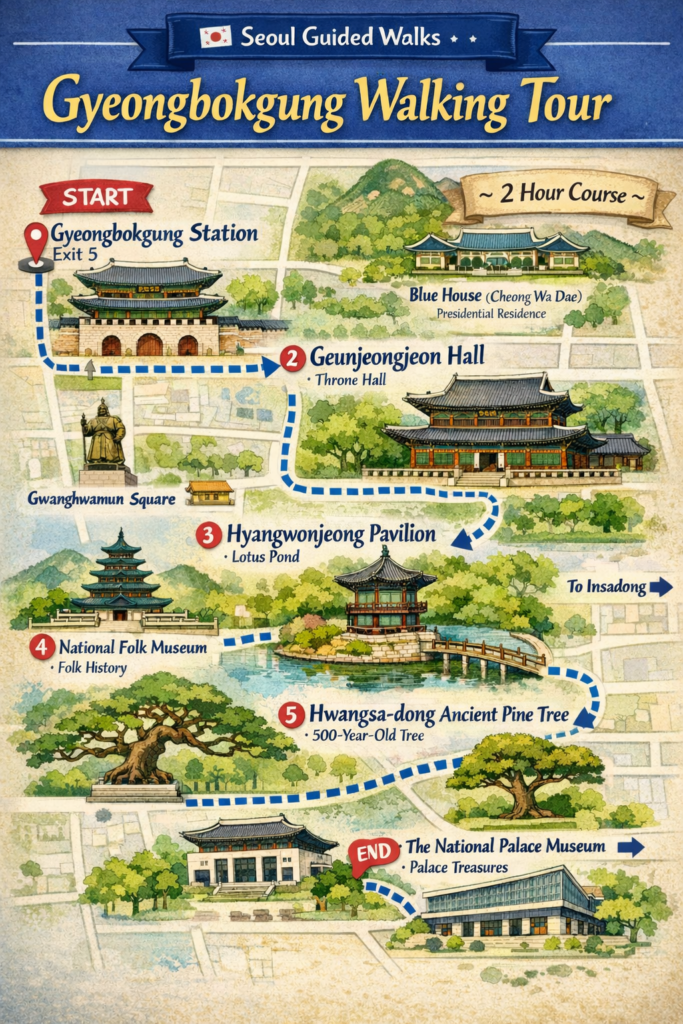
    Illustrated English navigation map for the Gyeongbokgung Walking Tour in Seoul, showing the main route, major landmarks, and an approximate 2-hour course.

    If this is your first time in Seoul, Gyeongbokgung is one of the strongest courses to recommend. Gyeongbokgung is the largest of Seoul’s royal palaces and one of the city’s clearest introductions to Joseon history, royal architecture, and traditional urban symbolism. As a first walking tour, it works especially well because visitors can immediately connect Seoul’s modern skyline with the city’s dynastic past.

    This course fits travelers who want a classic “must-do in Seoul” experience. It is ideal for first-time visitors, history lovers, and travelers who want their first cultural activity in Seoul to feel iconic, easy to understand, and visually memorable.

    2. Best for Traditional Atmosphere: Bukchon Hanok Village
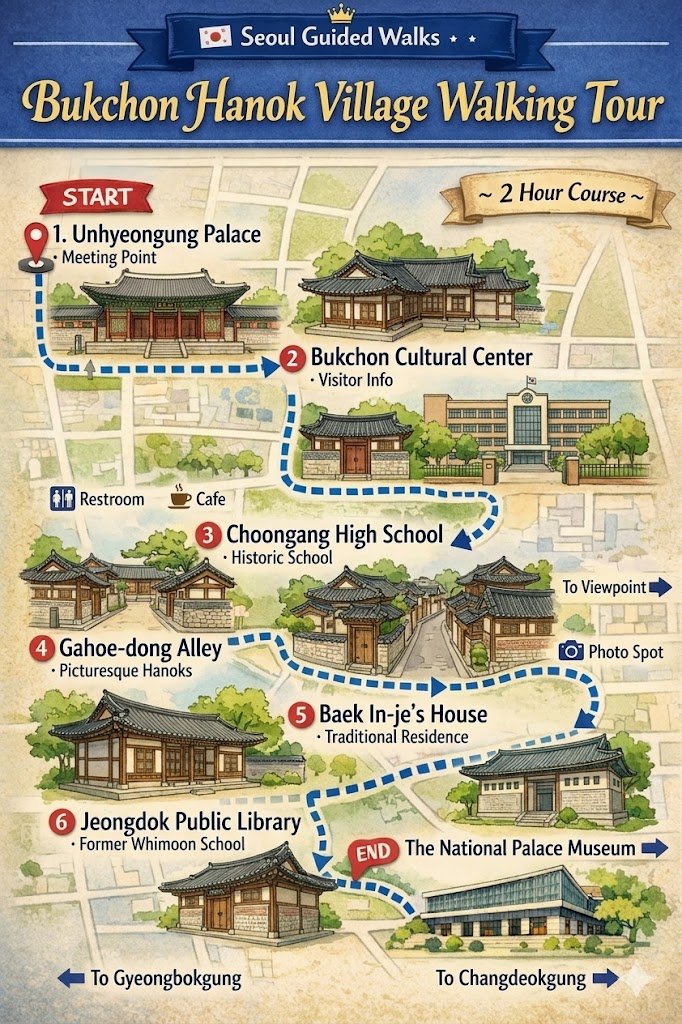
    An illustrated poster with a vintage map design for the 'Bukchon Hanok Village Walking Tour' in Seoul. The poster has a decorative banner at the top that reads "Seoul Guided Walks." The map shows a detailed blue walking path with numbered stops, starting at '1. Unhyeongung Palace (Meeting Point)' and ending at '6. Jeongdok Public Library.' Other key locations including the 'Bukchon Cultural Center,' 'Choongang High School,' 'Gahoe-dong Alley,' and 'Baek In-je's House' are depicted with charming traditional Hanok building illustrations. Icons for a Cafe, Restroom, Viewpoint, and Photo Spot are along the route. The map is set against a parchment background and includes arrows pointing "To Gyeongbokgung" and "To Changdeokgung" and a scroll that says "~ 2 Hour Course ~".

    Bukchon Hanok Village is one of the best picks for travelers who want to feel the texture of old Seoul rather than just visit one landmark. The official route description presents Bukchon as the only area in Seoul where large clusters of traditional hanok homes remain together, along with museums, workshops, and cultural resources spread through its maze-like alleys.

    This is a strong course for visitors who enjoy photography, architecture, slower walking, and a more emotional sense of place. It also pairs naturally with nearby palace areas, so it works well for travelers planning a half-day around Seoul’s historic center.

    If you are planning to stay in a more traditional part of Seoul, you may also want to read our guide to Best Hanok Stays in Seoul for First-Time Visitors.

    If you want to stay close to Bukchon, Gyeongbokgung, or Anguk for an easier walking itinerary, it helps to compare hotel locations before booking.

    A Trip.com promotional banner featuring a diverse family and an older Korean woman smiling together in a traditional Hanok setting, with N Seoul Tower in the distance. The banner includes a main headline 'STAY IN HISTORY, MAKE FAMILY MEMORIES.' and a close-up of a smartphone displaying Trip.com's hotel price map for Seoul's historic center.

    Compare Seoul hotel options near the historic center on Trip.com.

    3. Best for Modern History: Deoksugung and Jeongdong
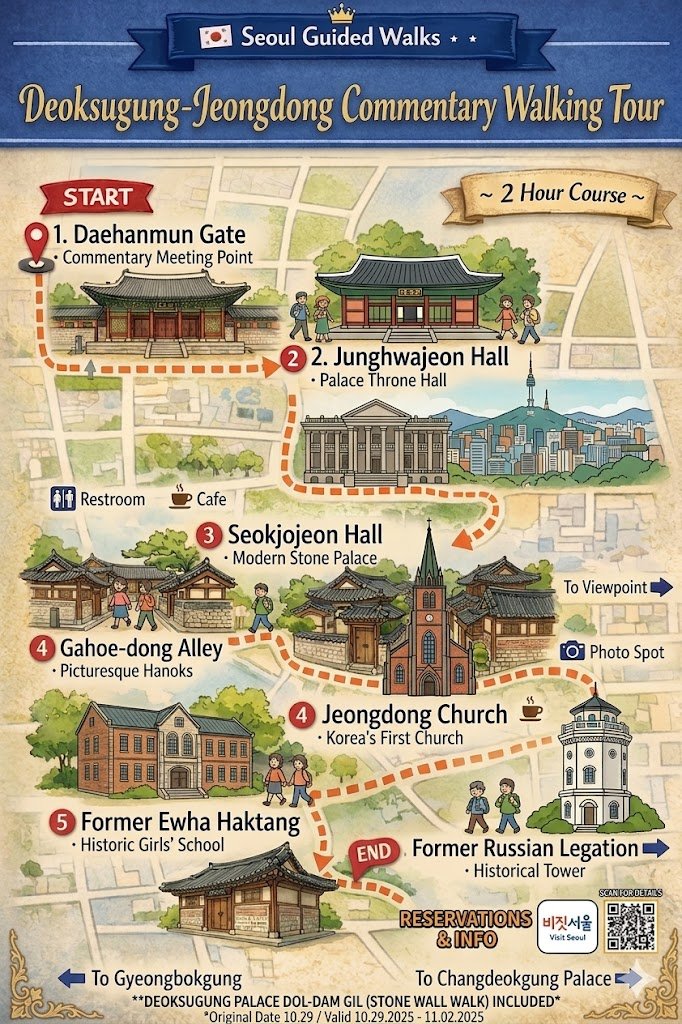
    A detailed infographic-style poster map guiding a two-hour commentary walking tour in Seoul, focusing on Deoksugung Palace and the Jeongdong area. The vintage-style poster, set on parchment paper with gold and blue banners, lists six main historical locations along a curving path marked with an orange arrow. The locations are: 1. Daehanmun Gate (Commentary Meeting Point), 2. Junghwajeon Hall (Palace Throne Hall), 3. Seokjojeon Hall (Modern Stone Palace), 4. Jeongdong Church (Korea's First Church), 5. Former Ewha Haktang (Historic Girls' School), and 6. Former Russian Legation (Historical Tower). Each location is represented by a small, detailed illustration. The poster includes small icons for Restroom, Cafe, and a Photo Spot near Gahoe-dong Alley and points to Viewpoints. Bottom pointers indicate directions to Gyeongbokgung and Changdeokgung Palaces. The text DEOKSUGUNG PALACE DOL-DAM GIL (STONE WALL WALK) INCLUDED is prominent at the bottom, alongside booking information, a 'Visit Seoul' logo, and a QR code. A small disclaimer at the bottom edge provides specific historical date information for a valid period of 2025-11-02. Illustrated characters are shown walking along the path.

    For visitors who want more than palace history, the Deoksugung-Jeongdong area is one of the most rewarding choices. Official route information describes Jeongdong as a walkable area where visitors can feel culture and history together in the center of Seoul, with strong links to Korea’s modern history.

    This course is a great fit for travelers who are interested in the Korean Empire period, Western-style buildings, diplomatic history, and the layered transformation of Seoul into a modern capital. It feels quieter and more reflective than some of the city’s palace-heavy routes, which makes it especially appealing for thoughtful travelers.

    4. Best for Views and Outdoor Walking: Namsan Fortress
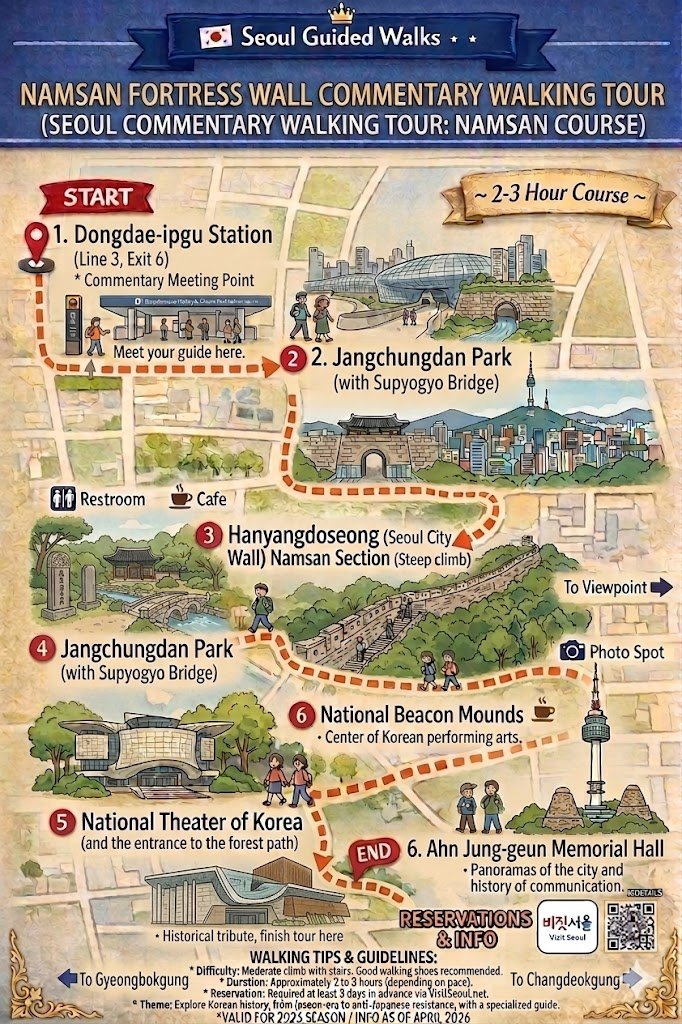
    A vintage-style illustrated map for the Namsan Fortress Wall Commentary Walking Tour in Seoul. The map is set on a parchment-textured background with a blue banner at the top. The route is marked with an orange dashed line and numbered points: 1. Dongdae-ipgu Station (Line 3, Exit 6) as the meeting point, 2. Jangchungdan Park (with Supyogyo Bridge), 3. Hanyangdoseong Namsan Section (marked as a steep climb), 4. National Theater of Korea, 5. National Beacon Mounds, and 6. Ahn Jung-geun Memorial Hall as the end point. Detailed watercolor-style illustrations represent each landmark, including the N Seoul Tower and sections of the city wall. The poster includes icons for restrooms, cafes, and photo spots. The bottom section features 'WALKING TIPS & GUIDELINES' in English, including difficulty levels and reservation info, alongside the 'Visit Seoul' logo and a QR code for more details. Blue arrows at the bottom indicate directions to Gyeongbokgung and Changdeokgung.

    Namsan Fortress is one of the most attractive options for travelers who want a scenic walk with both history and city views. The official course description highlights a route that combines Joseon-era historic sites with modern cultural spaces such as the National Theater and N Seoul Tower, while also connecting to traditional elements like Namsangol Hanok Village.

    This course works especially well for spring and autumn visitors, outdoor walkers, and anyone who wants a more panoramic and active version of Seoul sightseeing. Instead of focusing only on one monument, it gives travelers a broader sense of how Seoul’s landscape, fortifications, and city identity fit together.

    5. Best for Hidden Seoul: Walk Along Seochon’s Old Alleys
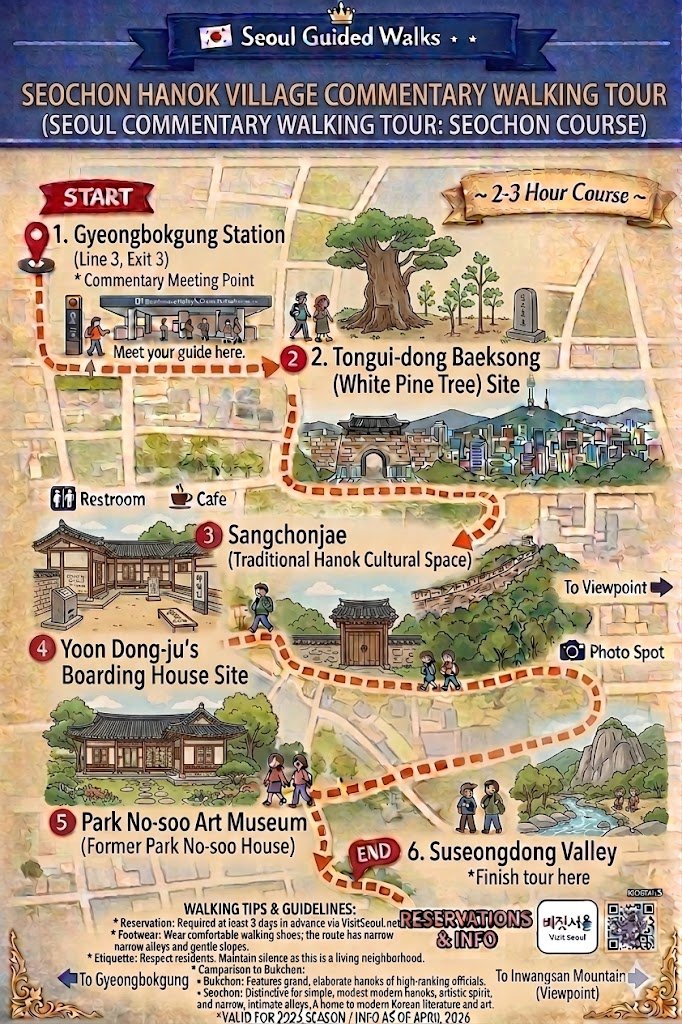
    A vintage-style illustrated map for the Seochon Hanok Village Commentary Walking Tour in Seoul. The map is set on a parchment-textured background with a blue banner at the top. The route is marked with an orange dashed line and numbered points: 1. Gyeongbokgung Station (Line 3, Exit 3) as the meeting point, 2. Tongui-dong Baeksong (White Pine Tree) Site, 3. Sangchonjae (Traditional Hanok Cultural Space), 4. Yoon Dong-ju's Boarding House Site, 5. Park No-soo Art Museum (Former Park No-soo House), and 6. Suseongdong Valley as the end point. Detailed watercolor-style illustrations represent each landmark, including traditional Korean houses and the scenic valley. The poster includes icons for restrooms, cafes, and photo spots. The bottom section features 'WALKING TIPS & GUIDELINES' in English, providing reservation info, footwear advice, and a comparison between Bukchon and Seochon. It also includes the 'Visit Seoul' logo and a QR code for reservations. Blue arrows at the bottom indicate directions to Gyeongbokgung and Inwangsan Mountain.

    Seochon is a great recommendation for travelers who want a quieter, more local side of Seoul. The official route description says this walk follows traces from the Joseon Dynasty, the Japanese colonial period, and the present day, while also highlighting the marks left by many artists who lived in the area.

    This makes Seochon especially attractive for travelers who prefer atmosphere over checklist tourism. It feels less like a “big attraction route” and more like a slow cultural walk through layers of memory, everyday life, and neighborhood character.

    If you are interested in staying somewhere with more local atmosphere, you may also want to read Types of Accommodation in South Korea: Hotels, Guesthouses, Hanok Stays & More.

    6. Best for Families and Accessible Travel: Family and Barrier-Free Courses

    Seoul’s walking tour system is not limited to standard adult sightseeing routes. The program also includes family-focused and accessible options. Official route pages show a family course at Gyeongbokgung, and the barrier-free Gyeongbokgung course is specifically described as being designed for seniors, wheelchair users, and stroller users through routes without major physical obstacles such as steps or thresholds.

    That makes this program especially useful for multigenerational travel, slower-paced family itineraries, and visitors who want an official cultural activity that is more inclusive than a typical walking route. For international travel blogs, this is a valuable point because many readers are actively looking for family-friendly or accessibility-conscious experiences in Seoul.

    7. Best for Younger Travelers: K-pop Landmark Walking Tour
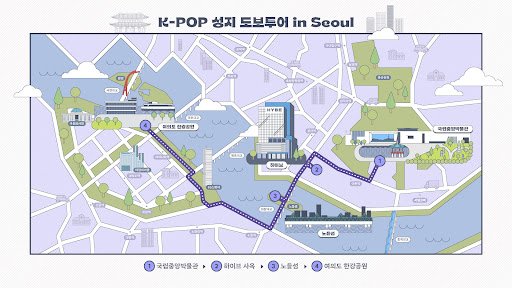
    K-POP Landmark Walking Tour: Route 1

    Title: Healing on the Han River: A Journey from History to K-POP

    Tour Course Sequence

    1. START: National Museum of Korea
      • (국립중앙박물관 / Meeting Point: Mirror Pond)
    2. HYBE Headquarters
      • (하이브 사옥 / The landmark of Yongsan)
    3. Nodeul Island
      • (노들섬 / Music & Art Island in the Han River)
    4. END: Yeouido Hangang Park
      • (여의도 한강공원 / A scenic riverside rest area)
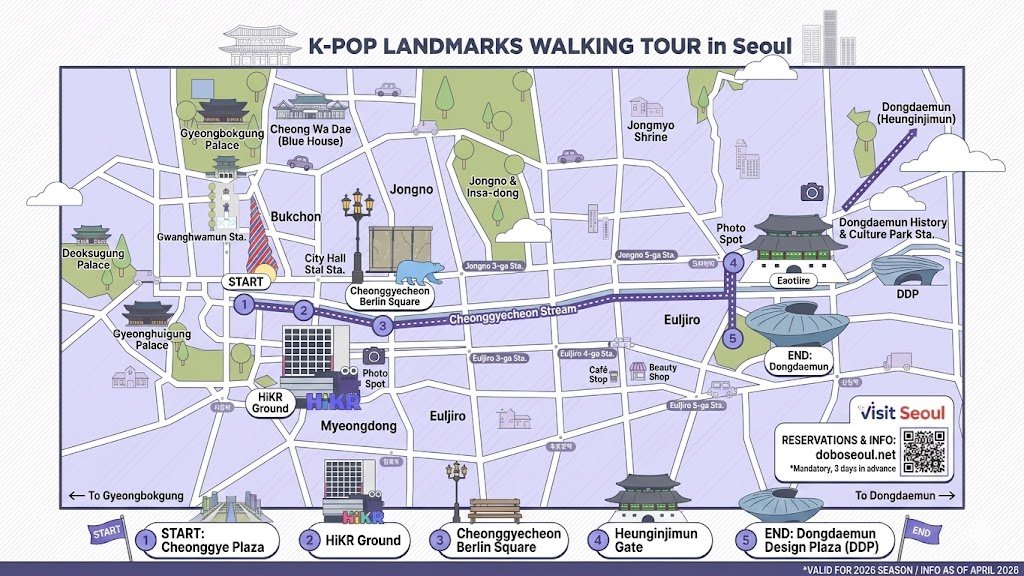
    English title and sequence for K-POP Landmark Walking Tour Route 2, featuring Cheonggye Plaza, HiKR Ground, Berlin Square, Heunginjimun Gate, and DDP.

    K-POP Landmark Walking Tour: Route 2

    Title: K-Culture Hub: From Historic Gates to Interactive K-POP Experiences

    Tour Course Sequence

    1. START: Cheonggye Plaza
      • (청계광장 / The starting point of Cheonggyecheon Stream)
    2. HiKR Ground
      • (하이커 그라운드 / Interactive K-Content & K-POP experience center)
    3. Cheonggyecheon Berlin Square
      • (청계천 베를린광장 / A symbolic cultural space along the stream)
    4. Heunginjimun Gate
      • (흥인지문 / Seoul’s historic East Gate)
    5. END: Dongdaemun Design Plaza (DDP)
      • (동대문 디자인플라자 / An iconic landmark for fashion and modern K-Design)
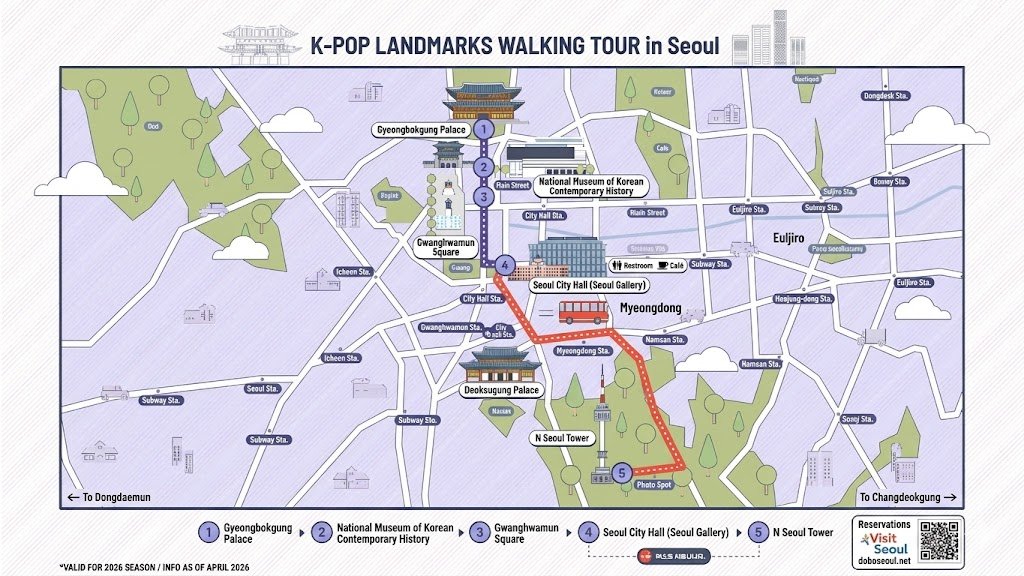
    영어 파일명:
k-pop-landmark-walking-tour-route-3-map.png

Alt text (대체 텍스트):
An English-language illustrated map of the 'K-POP Landmarks Walking Tour (Route 3)' in Seoul. The map displays a walking path (purple dotted line) and a bus transfer section (red dotted line). The five numbered stops are: 1. Gyeongbokgung Palace, 2. National Museum of Korean Contemporary History, 3. Gwanghwamun Square, 4. Seoul City Hall (Seoul Gallery), and 5. N Seoul Tower. The bus icon indicates transportation from Seoul City Hall toward the N Seoul Tower area. Other landmarks shown include Deoksugung Palace, Myeongdong, and various subway stations like City Hall Sta. and Gwanghwamun Sta. A 'Visit Seoul' reservation box with a QR code and the URL 'doboseoul.net' is located at the bottom right. The map uses a clean vector style with representative icons for traditional palaces and the N Seoul Tower.

    K-POP Landmark Walking Tour: Route 3

    Title: Seoul’s Heritage & Future: From Royal Palaces to the Iconic N Seoul Tower

    Tour Course Sequence

    1. START: Gyeongbokgung Palace
      • (경복궁 / The grandest of the Five Grand Palaces)
    2. National Museum of Korean Contemporary History
      • (대한민국역사박물관 / Features special K-Culture exhibitions)
    3. Gwanghwamun Square
      • (광화문광장 / The historical and cultural heart of Seoul)
    4. Seoul City Hall (Seoul Gallery)
      • (서울시청 서울갤러리 / A bridge between historical and modern Seoul)
      • [Transfer to Bus]
    5. END: N Seoul Tower
      • (N서울타워 / Located in Namsan Park, offering a panoramic view of the city)

    For younger visitors and global K-pop fans, Seoul has also promoted a K-pop Landmark Walking Tour in Seoul as a special limited-time program. Seoul Metropolitan Government’s official event guide describes it as a guided walking program across three routes, where visitors explore well-known K-pop spots, including music video filming locations, together with some of Seoul’s best-known landmarks.

    One official route example connects the National Museum of Korea, HYBE Headquarters, Nodeul Island, and Yeouido Hangang Park. Another highlighted route links Gyeongbokgung Palace, the National Museum of Korean Contemporary History, Gwanghwamun Square, Seoul City Hall, and N Seoul Tower. This kind of structure makes the K-pop section especially attractive for younger travelers because it blends fan interest, city storytelling, photo spots, and broader sightseeing into one experience.

    Because these routes connect multiple parts of Seoul, it also helps to understand how public transportation works before you go. You can start with Transportation in Korea: Complete Guide for Tourists.

    If you plan to use the subway or buses between tour areas, our T-Money Card in Korea: Complete 2026 Guide for Tourists (Including NAMANE Card & Discover Seoul Pass) will help you understand the easiest way to get around.

    For a travel blog, this section is worth including because it modernizes the image of Seoul’s guided walking tours. It shows that the program is not only for palace lovers or history-focused travelers, but also for visitors who want trend-driven, pop-culture-friendly experiences in the city. Because these K-pop routes are presented as special programming, readers should always check the live booking page for current availability.

    If you are looking for more K-culture experiences beyond the official walking tours, Seoul also offers bookable activities for international visitors.
    Promotional banner for a Creatrip K-Beauty Package in Seoul featuring skincare, hanbok styling, head spa, and teeth scaling experiences with a Book Now call to action.

    Explore Seoul experiences on Creatrip.

    How to Book

    The official Seoul Guided Walking Tour system directs visitors to book through the dedicated reservation site. The booking pages show tabs for individual bookings, group bookings, and mobility-impaired/disabled visitors, and the site notes that tours operate when the minimum reservation requirement is met. The booking page also shows that maximum capacity depends on the course, with some palace routes allowing more participants than others.

    Because course schedules, languages, and special seasonal routes can change, the safest advice is simple: check the live reservation page before making your plan. That is especially important for international visitors who want a specific language slot or want to join the K-pop routes while they are running.

    Final Thoughts

    If you want to experience Seoul beyond surface-level sightseeing, this is one of the most practical official activities to recommend. It is free, cultural, flexible, and varied enough to fit many travel styles—from first-time palace visits and hanok walks to scenic fortress routes, family-friendly options, and even K-pop-themed walks for younger travelers. Official public guidance currently presents the program as offering more than 40 courses, which is why it works so well as a broad “Activity” category topic rather than a single one-off attraction post.

    Official Booking and Contact Information

    Official overview:
    https://english.visitseoul.net/walking-tour

    Official reservation site:
    https://dobo.visitseoul.net/main/index?lang=en

    Inquiry phone:
    02-6925-0777

    Inquiry email:
    walkingtours@sto.or.kr

    General tourist helpline:
    1330
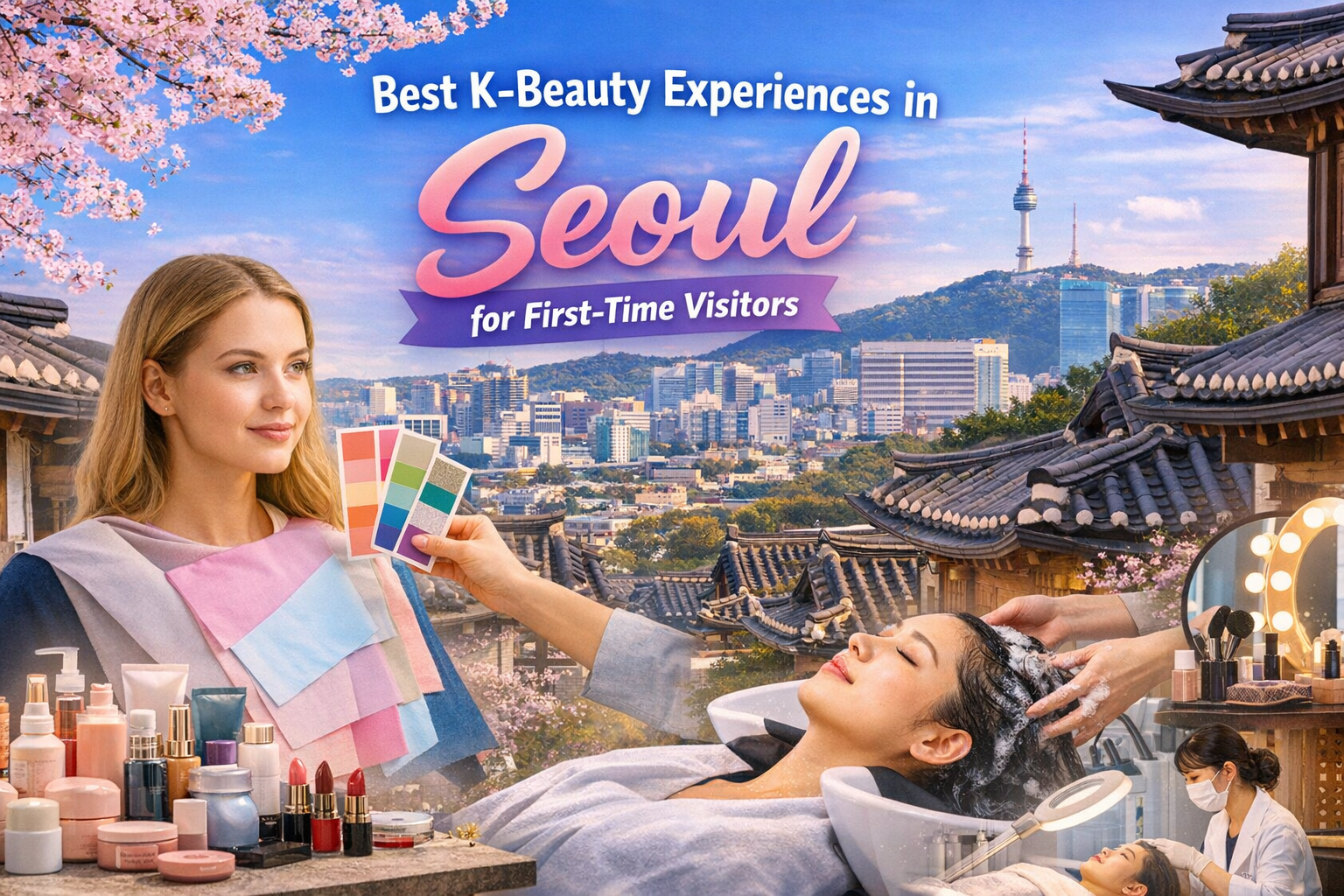
  • Best K-Beauty Experiences in Seoul for First-Time Visitors

    Best K-Beauty Experiences in Seoul for First-Time Visitors

    If you are visiting Seoul for the first time, trying a K-beauty experience can be one of the most memorable parts of your trip. The problem is that there are now so many options that it can feel hard to know where to start. Some travelers want a simple shopping experience at Olive Young. Others are curious about personal color analysis, Korean hair salons, head spa treatments, or even skin clinics. Seoul now has a wide range of foreigner-friendly beauty options, and platforms like Creatrip actively feature English-friendly booking, treatment guides, and curated recommendations for travelers.

    The good news is that you do not need to try everything. Your first K-beauty experience should match your comfort level, your travel style, and how much time you want to spend. Some experiences are easy and low-pressure, while others require more planning. This guide will help you understand the main types of K-beauty experiences in Seoul and choose the one that makes the most sense for your first trip.

    What Counts as a K-Beauty Experience in Seoul?

    When people hear “K-beauty,” they often think only about skincare products or sheet masks. But in Seoul, K-beauty experiences are much broader than that. For travelers, they usually fall into three main categories.

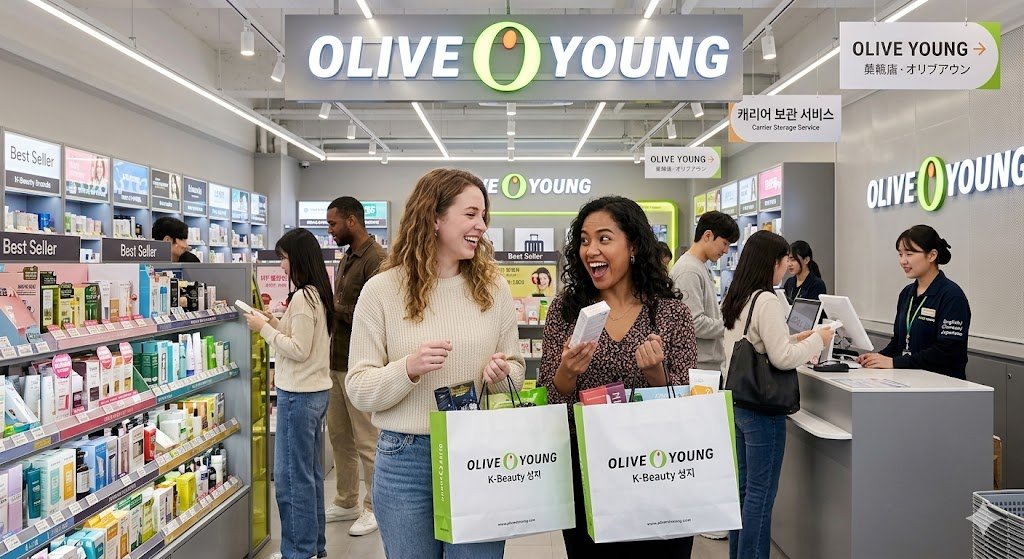
    Two foreign female tourists smiling brightly while holding Olive Young shopping bags inside a K-beauty store in Korea.

    1. Beauty shopping

    This is the easiest entry point. You can browse skincare, makeup, masks, and sunscreen without making an appointment. It is low-pressure and works well for travelers who want to explore Korean beauty casually.

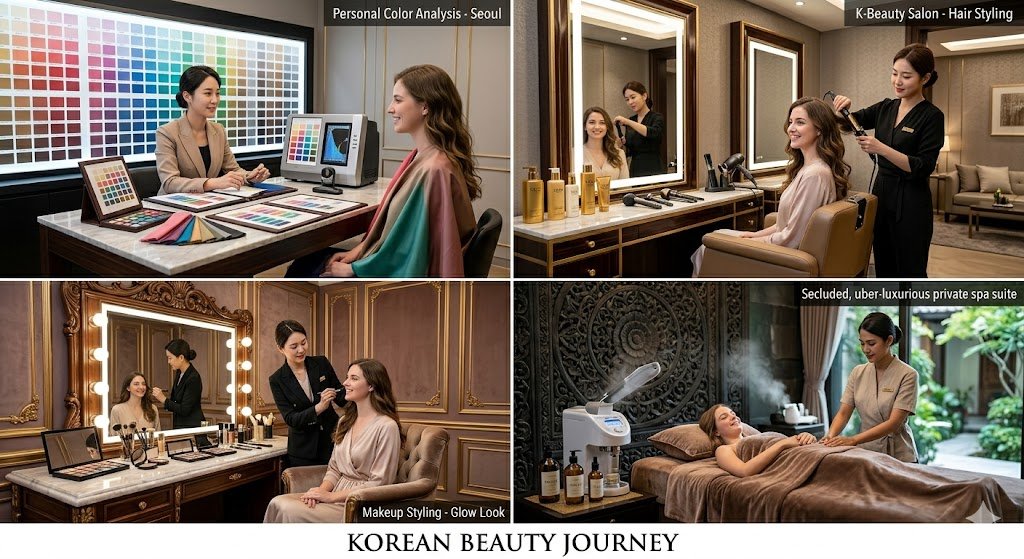
    A collage showing a foreign female tourist enjoying a luxurious K-beauty experience in Seoul, including personal color analysis, high-end hair styling, premium makeup services, and a relaxing head spa treatment."

    2. Beauty services

    These include things like personal color analysis, hair salons, makeup styling, and head spa treatments. These experiences are often more memorable than shopping because they are interactive and tailored to you. Personal color analysis and head spa treatments, in particular, have become very popular with foreign visitors in Seoul.

    A collage showing the clean interior of a modern Korean skin clinic, private treatment rooms, and a patient receiving professional laser and skincare treatments, with text that reads 'Foreigner-Friendly Korean Skin Clinics'.

    3. Skin clinic visits

    This is the most targeted option. Korean skin clinics are popular among travelers who already have specific skin concerns or want to try professional treatments while in Seoul. Creatrip’s recent clinic guides focus heavily on foreigner-friendly clinics in areas like Gangnam, Hongdae, and Myeongdong, showing how strong this category has become for international visitors.

    Best K-Beauty Experience for Beginners: Personal Color Analysis

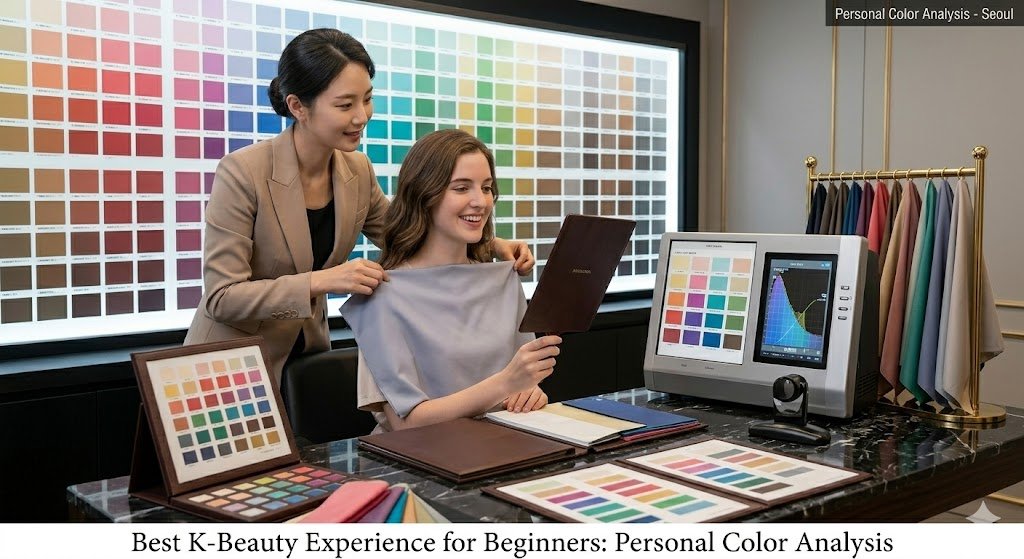
    A foreign woman smiling brightly as a Korean beauty consultant places a fabric drape over her during a personal color analysis in a professional studio. The desk is filled with color swatches and diagnostic equipment. Text reads 'Best K-Beauty Experience for Beginners: Personal Color Analysis'.

    For many first-time visitors, personal color analysis is one of the best places to start.

    Unlike a clinic treatment, it does not feel intimidating. Unlike shopping, it gives you a more personal and memorable result. During a personal color consultation, a specialist helps you understand which tones work best with your skin tone, hair, makeup, and clothing. Creatrip’s 2026 personal color guides continue to present this as one of the most accessible beauty experiences for foreign travelers in Korea.

    Personal color analysis works especially well for:

    • solo travelers
    • first-time K-beauty visitors
    • people interested in makeup, fashion, or hair color
    • travelers who want a beauty activity without going into clinical treatments

    It is also a practical experience. You do not just leave with pretty photos or a one-time service. You leave with information you can use later when choosing lipstick, clothing, hair color, or skincare packaging and makeup shades.

    If you want a beginner-friendly K-beauty experience in Seoul, personal color analysis is one of the easiest places to start.

    A professional marketing banner for Colorize Myeongdong featuring a personal color analysis session with a foreign tourist. The banner includes text 'DISCOVER YOUR PERFECT K-BEAUTY COLORS' and 'No. 1 Personal Color Analysis in Myeongdong, Seoul' with a 'BOOK NOW' button for Creatrip.

    Best for Specific Skin Concerns: Korean Skin Clinics

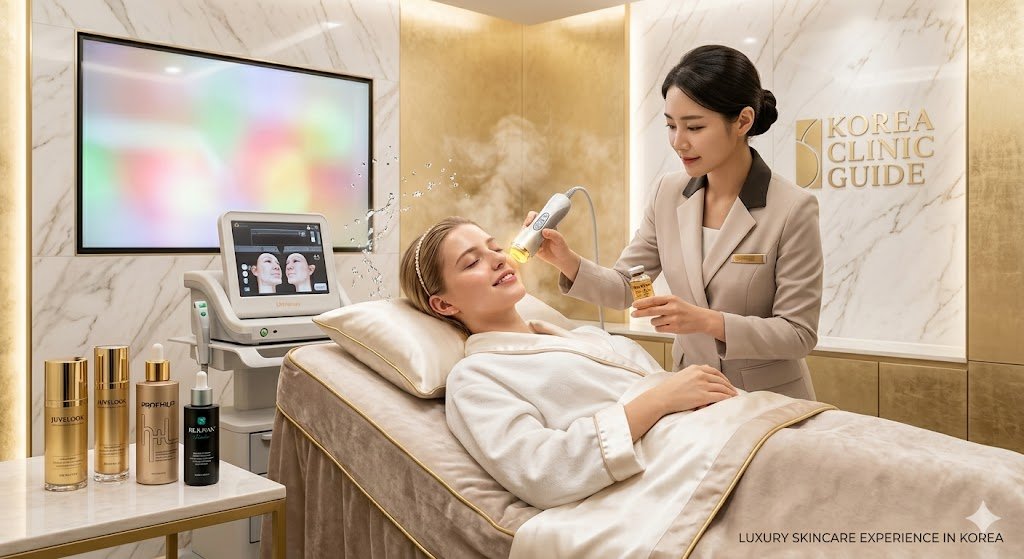
    A beautiful Caucasian female model receiving a premium facial treatment at a luxury Korean skin clinic. A professional dermatologist uses advanced medical devices for skin rejuvenation, with a digital screen showing 'KOREA CLINIC GUIDE' in a high-end marble and gold interior.

    If you are more interested in improving a particular skin concern, a Korean skin clinic may be the better fit.

    This option is best for travelers who already know what they are looking for, whether that is skin texture, dullness, acne-related concerns, or lifting-focused treatments. Creatrip’s 2026 clinic content now includes broader guides by skin concern, location, and even Sunday availability, which suggests that foreign visitors increasingly want more practical help choosing clinics rather than just seeing a simple list of treatments.

    A clinic visit may be a good choice if:

    • you already have some interest in Korean skincare treatments
    • you are comfortable booking appointments
    • you want more than just shopping or a relaxing beauty experience
    • you have enough time in Seoul to plan around the visit

    That said, this is not always the best first beauty activity for every traveler. If your trip is very short, or if you want something low-pressure and easy to enjoy, personal color analysis, head spa, or shopping may be a better first step.

    If you are more interested in treatments than shopping, Seoul’s skin clinics can be worth considering.

    Promotional banner for Medicube Clinic Gangnam, showing a premium Korean skincare clinic experience in Seoul with glowing skin, modern clinic interior, and a consultation scene for foreign visitors.

    Best for Relaxation: Korean Head Spa

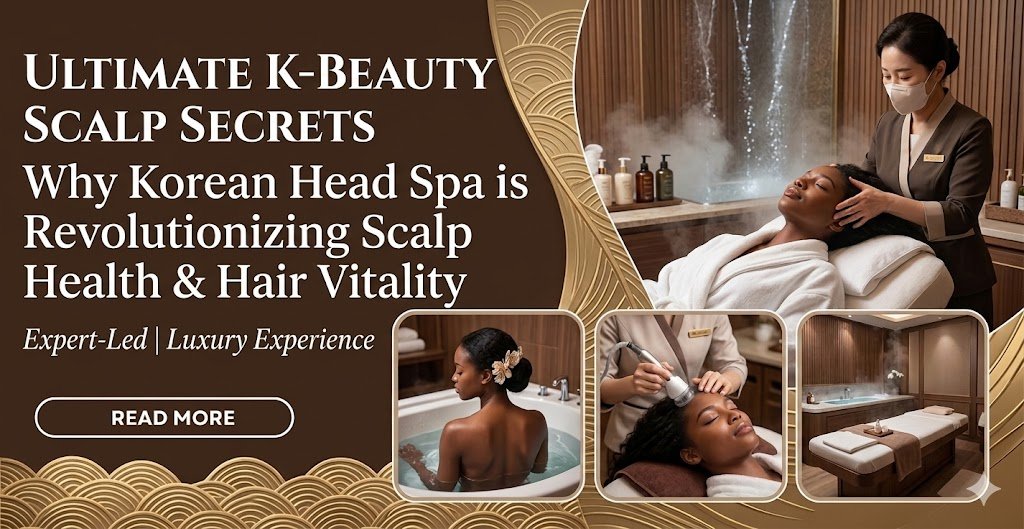
    A luxury marketing banner for Korea Ready Guide titled 'Ultimate K-Beauty Scalp Secrets.' It features a beautiful Black female model enjoying a premium Korean head spa treatment with steam and expert scalp massage in a high-end spa setting. Smaller inset photos show a hair-washing bed, a professional tool being used on the scalp, and a relaxing bathtub."

    If you want a K-beauty experience that feels relaxing rather than clinical, a Korean head spa is a strong choice.

    Creatrip’s current head spa guide highlights what to expect, how to book, and why this type of treatment has become especially popular among both locals and tourists. For many travelers, head spa treatments feel easier than clinics because they are wellness-oriented, low-pressure, and do not require much background knowledge about skincare or procedures.

    A head spa is especially good for:

    • travelers recovering from long flights
    • people who want a calm, low-stress beauty activity
    • couples or friends looking for a softer shared experience
    • visitors who like the wellness side of beauty culture

    This type of experience is also useful because it is easy to understand. You do not need to research ingredients or treatment menus in depth. You simply book, show up, and enjoy the process.

    A Korean head spa can be a great option if you want something relaxing instead of a clinical treatment.

    If you want a relaxing K-beauty experience in Seoul, a private head spa in Hongdae is one of the best places to start.
    Explore THE SEOL:HA Hanok on Creatrip.

    Promotional banner for THE SEOL:HA Hanok in Hongdae, featuring a relaxing private Korean head spa experience in a traditional hanok setting with organic vegan care and Creatrip booking call to action.

    Best for a Polished Look: Hair Salons and Styling

    Stylish featured image showing two foreign women and one foreign man with polished Korean hair styling, professional makeup, and elegant fashion in a modern studio composition inspired by Korean beauty trends.

    Another great option for first-time visitors is trying a Korean hair salon or styling service.

    Creatrip’s 2026 hair salon guides emphasize a few important points for foreigners: English consultation support, transparent pricing, and salons that are already used to working with international clients. That matters because many travelers are interested in Korean salon culture but worry about communication barriers or unclear pricing.

    This is a good choice for:

    • travelers who want a polished look for photos
    • people curious about Korean hair trends
    • visitors preparing for a special event
    • travelers who want a beauty experience without entering a clinic setting

    Compared with skin clinics, salons feel much easier for many beginners. You still get a distinctly Korean beauty experience, but without the pressure of choosing a treatment menu or thinking about recovery.

    If you want a more polished Seoul beauty experience, an English-friendly salon or styling appointment may be easier than starting with a clinic.

    Looking for a fresh new look in Seoul?
    Discover English-speaking hair color styling at CCONTE Seogyo.

    Promotional banner for CCONTE Seogyo in Seoul, featuring an English-speaking hair color styling experience with a foreign customer and Korean hairstylist in a modern salon setting.

    Best Low-Pressure Option: Olive Young Shopping

    Not every traveler wants to make appointments. If you prefer something simple, Olive Young is often the easiest first step into K-beauty in Korea.

    It is beginner-friendly, flexible, and easy to fit into almost any Seoul itinerary. You can browse sheet masks, sunscreen, soothing skincare, mini products, and gift-friendly items without needing to commit to a full beauty service. For cautious first-timers, this is often the least stressful option.

    Olive Young shopping works best for:

    • short-stay travelers
    • people without reservations
    • cautious beginners
    • visitors who want affordable beauty souvenirs or practical skincare basics

    This is also the easiest category to build from later. A traveler who starts with Olive Young may become more interested in personal color analysis, hair styling, or even clinic visits after gaining confidence.

    If you want the easiest entry into Korean beauty, start with shopping before moving on to more personalized experiences.

    Which K-Beauty Experience Should You Choose?

    If you are still unsure, here is a simple way to think about it.

    Choose personal color analysis if you want the most beginner-friendly and memorable beauty experience.

    Choose a skin clinic if you already have a specific skin concern and want a more targeted experience.

    Choose a head spa if you want something relaxing, easy, and wellness-focused.

    Choose a hair salon if you want a polished look and a distinctly Korean beauty service without going clinical.

    Choose Olive Young shopping if you want the lowest-pressure option and do not want to make appointments.

    The best first K-beauty experience in Seoul is not necessarily the trendiest one. It is the one that fits your trip, your comfort level, and your interest.

    Final Thoughts

    Seoul gives travelers a rare chance to experience beauty culture in many different ways. Some visitors want to shop. Others want a relaxing treatment. Some want a personalized consultation, while others are curious about clinics and advanced skincare.

    For first-time visitors, the smartest approach is to start with one experience that feels manageable rather than trying to do everything at once. Personal color analysis, head spa, hair salons, skin clinics, and Olive Young shopping all offer very different entry points into K-beauty. Seoul’s current foreigner-friendly beauty ecosystem is strong enough that you can now choose based on your travel style instead of simply choosing whatever looks most popular online.

    If you want a simple rule, this is the easiest one:
    start with the experience that feels the least stressful and the most useful to you. That is usually the best first K-beauty experience in Seoul.

  • Best Free K-Beauty Experiences in Seoul for Foreign Tourists

    Best Free K-Beauty Experiences in Seoul for Foreign Tourists

    Seoul is one of the best places in the world to explore K-beauty in person. However, many foreign visitors quickly realize that truly free beauty experiences are not always easy to find. Some places only offer product testing, while others provide actual services such as makeup touch-ups, skin analysis, or personal color consultations.

    This guide focuses on the best free K-beauty experiences in Seoul that foreign tourists can realistically try. It also explains what is actually free, whether reservations may be needed, and which places are most worth visiting depending on your travel style.

    If you are still planning the basics of your trip, you may also want to read our South Korea Travel Checklist Before You Fly.

    What Counts as a Free K-Beauty Experience in Seoul?

    Not every beauty space in Seoul offers a full free makeover. In many cases, “free” may mean a skin diagnosis, a personal color consultation, a makeup touch-up, or a promotional experience designed for foreign visitors.

    That is why it helps to know exactly what each place offers before you go. For this guide, the focus is on beauty experiences that foreign tourists can access in Seoul without paying for a full salon-style service.

    1. Beauty Play: The Best Free K-Beauty Stop for Foreign Tourists

    Beauty Play is the best place to start for most foreign visitors looking for a free K-beauty experience in Seoul.

    Unlike a typical beauty store promotion, Beauty Play feels more like an official K-beauty experience center. It is designed to introduce visitors to Korean beauty brands in a simple and approachable way, which makes it especially appealing for travelers who want to try K-beauty without pressure.

    One of the biggest advantages of Beauty Play is that it offers more than simple product displays. Visitors can explore services such as makeup experiences, skin diagnosis, and personal color diagnosis. In some cases, visitors can also receive product recommendations based on their skin type or beauty concerns.

    Beauty Play currently operates in Myeongdong and Hongdae, two areas that are especially convenient for foreign tourists. If you are planning how to move around Seoul between districts like Myeongdong and Hongdae, you may also want to read our How to Use the Seoul Subway as a Tourist (2026 Guide).

    Another reason Beauty Play stands out is that it appears to be especially foreigner-friendly. Some services are available on a walk-in basis, while certain programs or special sessions may require separate booking. There is also dedicated information for foreign visitors, which gives the overall experience a much more tourist-accessible feel than many other beauty spaces in Seoul.

    If you only have time for one free K-beauty stop in Seoul, Beauty Play is probably the strongest first choice. It is practical, beginner-friendly, and much easier to approach than trend-heavy beauty stores that can feel crowded or confusing for first-time visitors.

    2. The Hyundai Seoul: A Good Free Makeup Option for International Visitors

    If you are already planning to visit The Hyundai Seoul in Yeouido, this is another place worth checking.

    The Hyundai Seoul has been connected to special beauty-related experiences for foreign visitors through tourism pass promotions. This makes it one of the more polished and convenient department-store options for tourists who want to combine shopping with a short K-beauty experience.

    The most important thing to understand is that the free part appears to focus mainly on makeup-related experiences and personal color-style experiences, rather than a full free hair-and-makeup service.

    That distinction matters. If someone is specifically searching for a complete free hair-and-makeup session, The Hyundai Seoul may not fully match that expectation. However, if the goal is to enjoy a modern department-store-style K-beauty experience while visiting Yeouido, it can still be a very attractive option.

    If you are still deciding how to move around Seoul while visiting shopping districts like Yeouido, Myeongdong, or Hongdae, you may also want to read our Transportation in Korea: Complete Guide for Tourists.

    This is likely to be the best fit for travelers who already want to visit The Hyundai Seoul for shopping, dining, or sightseeing and would like to add a short beauty experience to the same trip.

    3. Olive Young N Seongsu: Trendy and Popular, but Not the Most Straightforward Free Option

    Olive Young N Seongsu is one of the most talked-about beauty spaces in Seoul, especially among beauty-focused travelers.

    It stands out for its strong trend appeal, highly visual store design, and experience-driven retail atmosphere. For visitors who enjoy discovering what is currently popular in Korea, it can be a very exciting stop.

    However, it is important to set expectations correctly. Olive Young N Seongsu is better understood as a trendy beauty retail space with selected consultation-based experiences, rather than a clearly structured free K-beauty experience center for tourists.

    That means it may still be worth visiting, but it is not necessarily the easiest or most reliable option for travelers who simply want a clear and guaranteed free beauty session. Demand can also be high, and some in-store services may require same-day booking or involve limited availability.

    If you plan to search locations, check reservations, or use maps while visiting beauty spots around Seoul, having mobile data can make the day much easier. Check South Korea eSIM options with Saily.

    Saily South Korea eSIM banner promoting mobile data for travelers visiting Seoul beauty spots, with a smartphone, Seoul landmarks, and call-to-action text

    Because many beauty-focused stops in Seoul require maps, bookings, or last-minute searches, it helps to stay connected during your trip. You may also want to read our SIM vs eSIM for South Korea in 2026: Which One Should You Choose?

    For that reason, Olive Young N Seongsu is best for visitors who already enjoy beauty shopping and do not mind a more fast-moving, retail-driven environment.

    4. Temporary Events, Pop-Ups, and Tourism Promotions

    In addition to fixed locations, Seoul sometimes has limited-time K-beauty events, tourism promotions, and pop-up experiences that foreign visitors may enjoy.

    These can be fun and worthwhile, especially if you happen to visit during a special campaign period. However, they are much less reliable for general trip planning because they may be seasonal, event-based, or available only for a short period.

    For most travelers, it makes more sense to treat these as bonus opportunities rather than the foundation of a beauty itinerary. In other words, it is better to plan around more stable places first and then add pop-ups or promotional events if your travel dates happen to match.

    How to Choose the Right Free K-Beauty Experience in Seoul

    If you want the most practical and foreigner-friendly option, Beauty Play is the best place to start. It offers the clearest free K-beauty experience for tourists and feels the most approachable for first-time visitors.

    If you are planning a shopping day in Yeouido, The Hyundai Seoul is a strong second option. It works especially well for travelers who want a short makeup-focused experience inside a modern department store.

    If you care more about trends, beauty shopping, and popular retail spaces, Olive Young N Seongsu may still be worth visiting. Just keep in mind that it is not the most straightforward “free beauty experience” in the way that Beauty Play is.

    Tips Before You Go

    Before visiting any free K-beauty experience in Seoul, it helps to keep a few things in mind.

    First, always check what is actually free. Some places offer makeup experiences, while others focus on skin analysis, personal color diagnosis, or product testing.

    Second, check whether reservations are needed. Some locations may allow walk-ins for general experiences, while others may require advance booking or same-day reservations for specific services.

    Third, remember that not every beauty experience is the same. A free K-beauty stop in Seoul often means a touch-up, consultation, or diagnostic experience rather than a full salon makeover.

    Even when the experience itself is free, you may still want payment-ready cards or mobile payment options for shopping, transportation, or beauty purchases afterward. You may also want to read our How to Pay in South Korea in 2026: Cash, Cards & Best Money Tips.

    Finally, choose the place that matches your travel style. Some visitors want a quick and easy beauty stop in a tourist area, while others enjoy trend-focused retail spaces and are willing to spend more time navigating busy stores.

    Final Thoughts

    Free K-beauty experiences in Seoul do exist, but the best ones are the places that are easy to access, clear about what they offer, and realistic for foreign tourists to use during a trip.

    For most visitors, Beauty Play is the best first choice. The Hyundai Seoul is a strong option if you want to combine shopping with a short beauty experience, while Olive Young N Seongsu is better for travelers who are more interested in beauty trends and retail exploration than in a simple free session.

    If you want to enjoy K-beauty in Seoul without spending much, these kinds of experiences can be a fun and practical way to start.

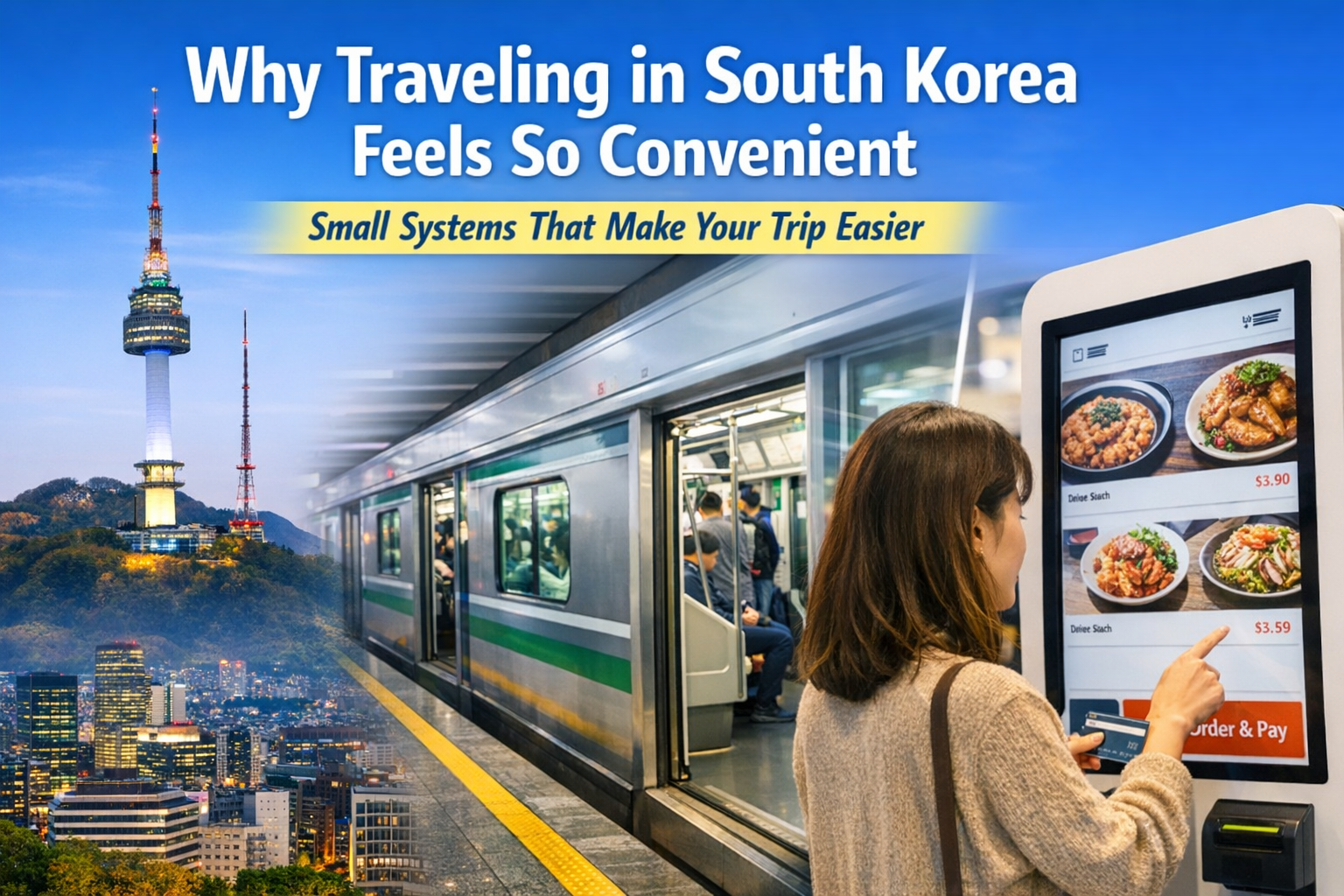
  • Why Traveling in South Korea Feels So Convenient: Small Everyday Systems Tourists Notice Right Away

    Why Traveling in South Korea Feels So Convenient: Small Everyday Systems Tourists Notice Right Away

    South Korea is not only popular for food, shopping, and famous attractions.

    For many travelers, one of the biggest surprises is how convenient daily life feels.

    Sometimes it is not one major attraction that stands out most. Instead, it is the small systems that make everyday travel easier.

    You notice it when public transportation works smoothly, when ordering food feels less stressful, when convenience stores solve small problems quickly, or when useful services are available faster than expected.

    These details may seem small at first, but together they make South Korea feel easier to navigate than many travelers expect.

    1. Public Transportation Feels Efficient and Connected

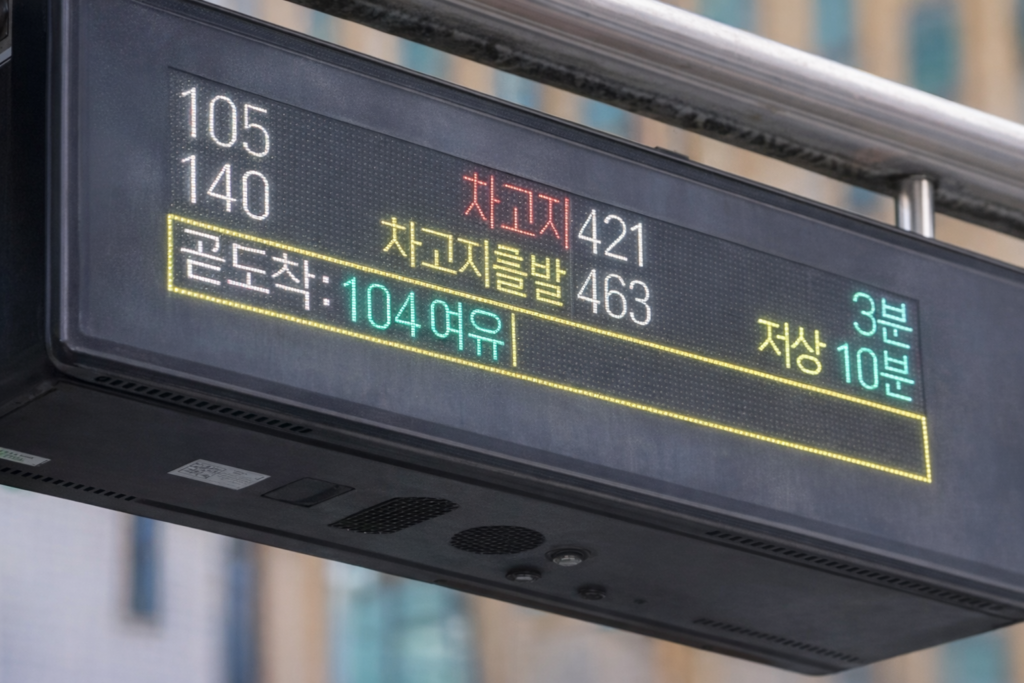
    Electronic bus information display in Seoul showing real-time bus arrival times, route numbers, and destination details at a bus stop.

    One of the first things many travelers notice in Korea is how practical public transportation feels.

    In Seoul and other major cities, it is often possible to move around easily without renting a car. Subways, buses, taxis, and walking routes connect well, which makes daily travel feel more manageable. Seoul’s public transportation system is also designed to work as an integrated system rather than a series of completely separate rides.

    The system also feels efficient in a very practical way.

    Bus arrival information is usually easy to check. Subway stations are organized clearly. Transfers are part of daily movement instead of feeling confusing or stressful. Official Seoul guidance explains that when you use a transportation card and transfer within the allowed time, transfer discounts apply rather than charging a completely separate full fare every time. In general, the transfer window is 30 minutes, or 1 hour between 9 PM and 7 AM the next day, and riders need to tap when getting off the bus for the discount to apply.
    That makes a real difference for travelers. When buses and subways feel connected in both movement and cost, getting around Seoul feels smoother and often more budget-friendly too. Seoul’s official English transportation guide also notes that T-money users can transfer between bus and subway lines, which helps daily travel feel more seamless.

    One important detail to remember is that transfer discounts in Korea generally apply when you use a transportation card such as T-money. That is one reason many travelers choose to get a transport card early in the trip, especially if they plan to use both buses and subways in Seoul.

    Horizontal Klook banner promoting Seoul transport card options, featuring a subway station scene, a T-money card, and a call to check transport card options on Klook.

    Want easier transfers in Seoul? Check Korea transport card options on Klook before your trip.

    If you want to understand the system better before your trip, read Transportation in Korea: Complete Guide for Tourists and How to Use the Seoul Subway as a Tourist (2026 Guide).

    2. Small Street Details Can Feel Surprisingly Smart

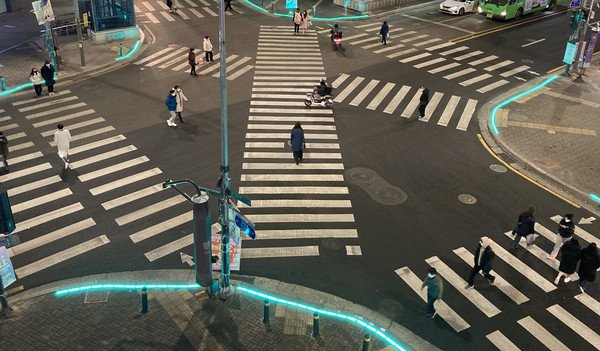
    Seoul crosswalk with floor-level traffic lights embedded along the curb to help pedestrians notice traffic signals more easily at night.

    Korea also stands out because of the small details built into city life.

    A simple example is the floor-level traffic light system seen in some areas. For pedestrians checking a map or looking at a phone, these lights make it easier to notice when the signal changes.

    It may sound minor, but details like this leave a strong impression.

    They make travelers feel that the city is designed around real daily behavior.

    Another example appears in winter. Some bus stops have heated seats, which can make waiting outside much more comfortable on cold days.

    These are not famous tourist attractions, but they are the kind of everyday details visitors often remember.

    3. Staying Online Feels Easier Than Many Travelers Expect

    A lot of travelers worry about internet access as soon as they land.

    They need it for maps, translation apps, taxi apps, hotel messages, and booking confirmations. That is one reason digital convenience matters so much during a trip.

    In Korea, staying connected often feels easier than expected.

    Mobile service is strong, digital tools are widely used, and public Wi-Fi can also help travelers feel less disconnected when they need quick online access.

    This makes a real difference during the trip. Being online is not just a bonus anymore. It affects navigation, food ordering, communication, and everyday movement.

    For first-time visitors especially, that digital convenience can make Korea feel much easier to handle.

    To use maps, taxi apps, translation tools, and booking confirmations smoothly throughout your trip, it helps to stay connected from the moment you arrive.

    Check South Korea eSIM options with Saily before your trip.

    Horizontal Saily eSIM banner in English showing a traveler with a smartphone, instant global connection, low-cost plans, and data refund benefits for South Korea travel.

    You can also read Do You Need an eSIM for South Korea in 2026? (Best Options Explained) and SIM vs eSIM for South Korea in 2026: Which One Should You Choose?

    4. Ordering Food Can Feel Less Stressful

    Ordering food in a new country can be uncomfortable for many travelers.

    Some worry about pronunciation. Others worry about ordering the wrong item or not understanding the menu clearly.

    In Korea, self-service ordering systems often make that easier.

    In many casual restaurants, cafes, and fast-food places, ordering through a kiosk is already normal. That means travelers often do not need to explain everything out loud first.

    Instead, they can take their time, look through the menu, choose what they want, and pay step by step.

    For solo travelers, this can feel especially convenient. It makes eating alone feel simpler and less awkward.

    5. Convenience Stores Are More Useful Than Many Travelers Expect

    Convenience stores in Korea are not just for grabbing a quick drink.

    For many travelers, they become one of the most useful parts of daily travel.

    You can quickly buy snacks, drinks, simple meals, toiletries, and small travel essentials. In some places, you can also prepare food right there, which makes convenience stores feel much more practical than many visitors expect.

    That is one reason so many travelers become interested in Korean convenience store culture.

    It is not only accessible. It is also efficient.

    If you need a simple breakfast, a late-night snack, a quick drink, or a fast solution to a small problem, convenience stores are often one of the easiest answers.

    6. Han River Food Culture Feels Especially Easy and Fun

    Another thing that surprises many visitors is how easy outdoor food culture can feel in Korea.

    At the Han River, people enjoy picnics, instant ramen, drinks, and even delivery food in a relaxed public space. For foreign travelers, this can feel both practical and memorable.

    It is one of those experiences that feels very Korean.

    Convenience stores are nearby. Public space is easy to use. Food options are accessible. Delivery culture is strong.

    As a result, even a simple afternoon by the river can feel easy to plan and enjoyable to experience.

    One especially memorable example is cooking instant ramen from a convenience store and eating it by the Han River. For many young travelers, that becomes one of the most fun and local-feeling parts of the trip.

    7. Shared Bikes and Scooters Help With Short Trips

    Korea also feels convenient because short-distance movement inside the city can be easier than expected.

    Shared bikes and electric scooters can help with that final short distance between a subway station, a cafe street, a park, or a riverside area.

    Sometimes a place feels too far to walk comfortably, but too short for a taxi. In those situations, shared mobility can feel very useful.

    This kind of system makes city exploration feel lighter and more flexible.

    For travelers exploring Seoul, it adds to the feeling that the city is designed for practical daily movement.

    8. Fast Service Culture Shows Up in Everyday Life

    Some of Korea’s convenience does not come from tourism infrastructure at all.

    It comes from everyday service culture.

    One example is eyewear. In many countries, getting glasses can take a long time. In Korea, some travelers are surprised by how quickly vision tests and glasses preparation can happen compared with what they are used to at home.

    Another example is fast delivery culture.

    Many travelers already know that Korea is fast, but they often do not fully understand that until they see how quickly items can arrive or how easy it is to get something delivered.

    This creates a strong impression that Korea is not just modern. It is organized around saving time in daily life.

    9. Daily Travel Often Feels Easy Without a Car

    One of the most impressive things about Korea for many travelers is that daily life in major cities can feel very functional without driving.

    You can arrive from the airport, reach your hotel, use public transportation, buy what you need, eat well, and move between neighborhoods without depending on a car.

    That matters because in many destinations, transportation becomes one of the biggest sources of stress.

    In Korea, the system often reduces that stress instead of adding to it.

    This is especially useful for first-time visitors, solo travelers, and people planning shorter city trips.

    If you are planning your arrival and local movement, read How to Get from Incheon Airport to Seoul (2026 Guide) and How to Use Taxis in Korea (Kakao T, Uber & Tips).

    10. Safety Systems Also Add Peace of Mind

    Convenience is not only about speed.

    It is also about feeling supported when something goes wrong.

    That is another reason Korea can feel easier for travelers. Public systems, emergency response, and organized urban environments can help visitors feel more secure during the trip.

    In urgent situations, emergency services are available, which can be reassuring for travelers dealing with unexpected problems.

    However, emergency response is only one part of the picture. If you need hospital treatment, tests, or follow-up care, costs can still add up for international visitors. That is why travel medical insurance is worth considering before your trip.

    Check travel medical insurance options with SafetyWing before your trip.

    Horizontal SafetyWing travel insurance banner showing a traveler with luggage and smartphone, promoting global medical coverage, trip support, and 24/7 assistance.

    For more preparation tips, read Is South Korea Safe for Tourists in 2026? and Travel Insurance for South Korea – Complete 2026 Guide.

    11. Korea Feels Convenient Because Many Small Systems Work Together

    Poster showing a smiling foreign family in front of Gyeongbokgung Palace with a cheerful message encouraging a happy trip to South Korea.

    What makes travel in Korea feel easy is not just one attraction or one useful app.

    It is the way many small systems work together.

    Public transportation saves time. Convenience stores solve everyday problems. Kiosks reduce language stress. Public Wi-Fi and digital tools help travelers stay connected. Delivery culture adds flexibility. Shared mobility helps with short trips.

    Even small details like heated bus stop seats or floor-level traffic lights can make a difference.

    None of these things alone defines the whole trip.

    But together, they create a strong feeling that daily life in Korea is organized in a practical, traveler-friendly way.

    That is one reason many visitors leave with the same impression:

    South Korea is not only exciting to visit. It is also surprisingly easy to navigate once you are here.

  • Get the K-Pop Star Look: Best Idol Makeup Experiences in Seoul (2026 Guide)

    Get the K-Pop Star Look: Best Idol Makeup Experiences in Seoul (2026 Guide)

    Have you ever wondered how K-Pop idols achieve that flawless, glowing skin and polished stage-ready makeup?

    The secret is not just great products. It is the skill of professional Korean beauty artists who understand skin preparation, color balance, facial contouring, and the subtle styling details that make a look feel modern and camera-ready.

    The good news is that these beauty experiences are no longer limited to celebrities. Today, international travelers can book professional hair, makeup, and personal color sessions in Seoul and enjoy the same beauty culture that made K-beauty famous around the world.

    If you are still planning your trip, you may also want to read South Korea Travel Checklist Before You Fly before booking beauty experiences in Seoul.

    Whether you want a soft and natural Korean look, a glamorous idol-inspired makeover, or a full fashion-style photo experience, this guide covers some of the best K-beauty experiences in Seoul for 2026.


    1. Professional K-Pop Idol Makeup & Hair Styling (Cheongdam / Gangnam)

    Professional K-pop idol makeup and hair styling experience in Cheongdam and Gangnam, Seoul, showcasing a polished celebrity-style beauty look.

    If you want the most authentic idol-style beauty experience, Cheongdam and Gangnam are the best places to start.

    This area is known as one of the centers of Korea’s beauty and entertainment industry. Many of the city’s best-known salons are located here, and the overall experience feels more polished, premium, and image-focused than a standard tourist makeover.

    Why This Experience Stands Out

    Authentic Seoul beauty styling
    Gangnam and Cheongdam salons are known for refined Korean makeup looks, elegant hair styling, and trend-driven beauty techniques.

    Professional customization
    Instead of applying one standard look to everyone, artists usually adjust the makeup based on your face shape, skin tone, and the overall mood you want.

    A complete transformation
    Many visitors choose this type of session because it combines both beauty treatment and travel experience. It feels special, memorable, and highly photogenic.

    What to Expect

    A typical session usually lasts around 90 to 120 minutes.
    Most experiences include:

    • skin preparation
    • base makeup and complexion work
    • eye makeup and contouring
    • lip color styling
    • hair styling or finishing touches

    Some experiences may also include optional upgrades such as photo sessions or more personalized styling consultation.

    Helpful Tip

    If you already have a preferred style in mind, bring a few sample photos. This can make it easier to explain whether you want something natural, elegant, youthful, dramatic, or stage-inspired.

    Book Your K-Pop Makeup Experience

    Because these salons are popular with both locals and international visitors, advance booking is strongly recommended.

    To make bookings, check directions, and access reservation details more easily during your trip, see SIM vs eSIM for South Korea in 2026: Which One Should You Choose?

    For many foreign travelers, Klook is one of the easiest ways to reserve beauty experiences in Seoul because it is simple to compare options, check available times, and book in advance.

    Promotional banner for booking a K-pop idol hair and makeup session in Seoul on Klook, featuring a glamorous Korean-style beauty look.

    Book Your K-Pop Hair & Makeup Session on Klook


    2. Personal Color Analysis & Makeup Class (Hongdae / Yeonnam / Seongsu)

    Promotional image for a personal color analysis and makeup class in Seoul, showing beauty consultation scenes and professional Korean makeup training in Hongdae, Yeonnam, and Seongsu.

    If Gangnam is about polished transformation, Hongdae, Yeonnam, and Seongsu are more about discovery, creativity, and learning what actually suits you.

    If you are deciding where to stay, Best Areas to Stay in Seoul for Tourists (2026 Guide) can help you choose a neighborhood that matches your beauty and travel plans.

    This is where many travelers book personal color analysis sessions and beauty classes that help them better understand Korean makeup trends in a more practical and individualized way.

    Why Personal Color Analysis Is So Popular

    Personal color analysis has become one of the most talked-about beauty experiences in Korea.

    The idea is simple: certain colors naturally suit your skin tone better than others. A trained consultant helps identify whether you look better in warmer or cooler tones, and then narrows that down into more specific seasonal categories.

    This can help you better understand:

    • which lipstick shades suit you
    • which blush tones look natural on your face
    • which eye makeup colors brighten your features
    • which clothing colors work best for your complexion

    For many visitors, this is not just a fun activity. It is also one of the most useful beauty experiences they can take home with them after the trip.

    What Is Usually Included

    Many personal color sessions include:

    • tone and undertone analysis
    • fabric draping tests
    • explanation of best and worst color families
    • recommendations for makeup shades
    • practical styling advice

    Some sessions may also include makeup touch-ups or a beauty consultation based on your result.

    Why Travelers Love It

    This experience works especially well for:

    • solo travelers
    • friends traveling together
    • beauty-focused visitors
    • first-time K-beauty fans
    • travelers who want a practical experience, not just a photo opportunity

    Booking Tips

    These sessions are often limited because they require one-on-one consultation time. Walk-ins are usually difficult, especially for English-friendly bookings.

    If this is one of the experiences you most want to try in Seoul, it is better to reserve early.


    Stop Guessing and Find Your True Colors
    Personal color analysis is one of the most in-demand beauty experiences in Seoul. If you want a beauty activity that is both memorable and useful, this is one of the best options to book in advance.

    Promotional banner for booking a personal color analysis experience in Seoul on Klook, featuring a beauty consultation with seasonal color draping and Korean makeup guidance.

    Book Your Personal Color Analysis on Klook


    3. High-Fashion Editorial Photoshoot (Seongsu-dong)

    After your hair, makeup, or personal color session, Seongsu is one of the best areas in Seoul to turn your new look into a complete visual experience.

    If you plan to visit multiple beauty districts in one trip,Seoul Subway Map Guide for Tourists (2026 Updated Map) can help you understand the easiest subway connections.

    Often described as one of Seoul’s trendiest neighborhoods, Seongsu blends industrial buildings, fashion-forward cafes, concept stores, and creative urban streets. That mix makes it a great location for editorial-style photos and modern travel snapshots.

    Why Seongsu Works So Well

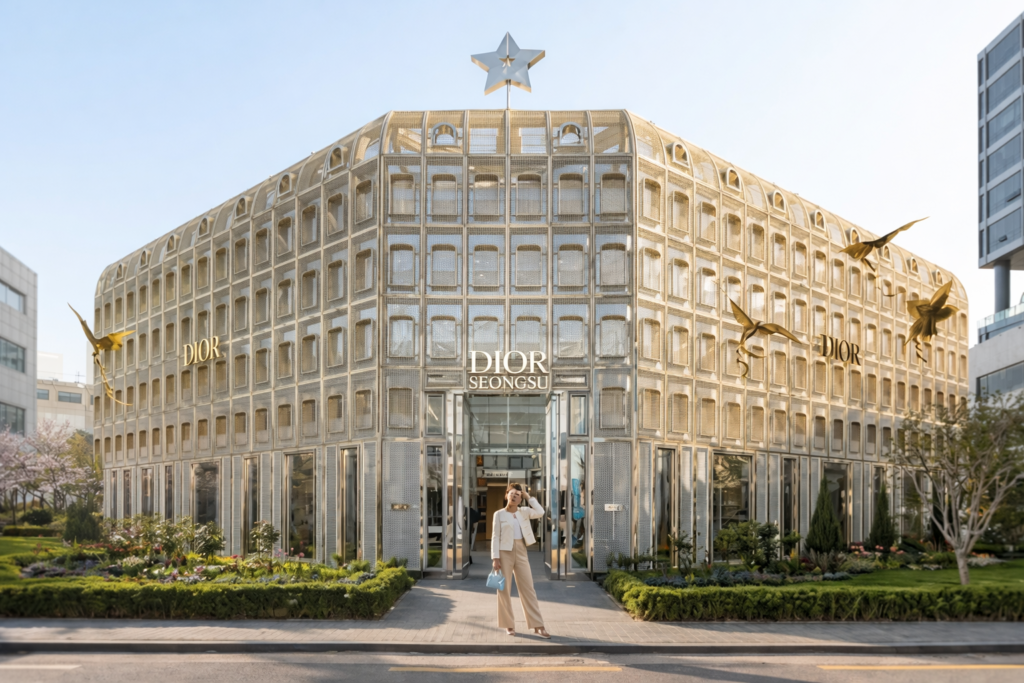
    Tourist taking a photo in front of the Dior Seongsu concept store in Seoul, featuring the iconic metallic facade and luxury fashion landmark setting.

    Unlike the polished luxury feel of Gangnam, Seongsu offers a more contemporary and artistic atmosphere.

    Industrial photo spot in Seongsu, Seoul, featuring old red-brick factory buildings, narrow urban streets, and a trendy retro atmosphere popular for street photography.

    You will find:

    • industrial-style streets
    • trendy cafes
    • fashion brand spaces
    • minimalist storefronts
    • stylish urban backdrops for photos
    Two foreign women posing for a unique street-style photo in front of a painted industrial wall in Seongsu, Seoul, with urban graffiti and a creative factory district atmosphere.

    This makes the area especially attractive for travelers who want photos that feel modern, fashionable, and different from standard tourist pictures.

    What the Photoshoot Experience Feels Like

    Many photo experiences in Seoul are designed for people with no modeling background, so you do not need to worry about posing experience.

    A typical session may include:

    • guidance on posing
    • help with natural facial angles
    • recommendations for the best local photo spots
    • edited final images
    • a more polished and professional result than casual phone photos

    This kind of activity works very well after a beauty session because your styling and location naturally complement each other.

    Make It a Full Beauty Day

    One of the best things about Seongsu is that you can combine several activities in one area.

    A possible itinerary could be:

    • start with a beauty or color session
    • move to a Seongsu photo area
    • visit concept stores or fashion spaces
    • stop by one or two popular cafes
    • end the day with stylish edited travel photos

    That makes this area a strong choice for travelers who want a beauty-focused day in Seoul rather than a single short appointment.

    Book Your Seongsu Photoshoot Experience

    If you want to turn your K-beauty experience into lasting travel photos, a Seongsu photoshoot is one of the best follow-up activities to book.

    Promotional banner for booking a Seongsu photoshoot on Klook, featuring a traveler posing on a trendy industrial street in Seongsu, Seoul, with a photographer capturing stylish travel photos.

    Book Your Seongsu Photoshoot on Klook


    Must-Visit Beauty & Fashion Spots in Seongsu

    Once your beauty experience is complete, Seongsu is a great place to continue the day.

    Tamburins Seongsu

    This is one of the most recognizable beauty and lifestyle destinations in Seongsu. The store is known for its striking design and artistic atmosphere, making it a popular stop for visitors interested in beauty, branding, and fashion culture.

    Why visit:
    The space itself feels like an art installation, and it works well as a stylish stop after a makeup or personal color session.

    Dior Seongsu

    Dior Seongsu is one of the most photographed concept-style spaces in Seoul.

    Why visit:
    Even from the outside, it creates a strong visual backdrop and adds a luxury fashion feel to your Seongsu itinerary.

    Musinsa Standard Seongsu

    If you want to explore Korean fashion after your beauty session, Musinsa Standard is one of the most approachable places to browse modern Korean basics and trend-aware styling.

    Why visit:
    It is a practical stop if you want to match your new beauty look with Seoul-style fashion pieces.


    Conclusion: Plan Your K-Beauty Experience in Seoul

    If you want more than a typical tourist activity, Seoul’s beauty experiences offer something far more memorable.

    You can start with a polished idol-style hair and makeup session in Gangnam, discover your ideal tones through personal color analysis in Hongdae or Seongsu, and then finish the day with a stylish photoshoot in one of Seoul’s most creative neighborhoods.

    This combination gives you more than just pretty pictures. It helps you experience one of the most globally influential parts of modern Korean culture in a personal and practical way.

    Whether your goal is transformation, learning, fun, or simply creating unforgettable travel memories, beauty experiences like these can become one of the highlights of your Seoul trip.

    If you are planning your arrival day, How to Get from Incheon Airport to Seoul (2026 Guide) can help you choose the easiest way to reach beauty districts like Gangnam, Hongdae, and Seongsu.

    Ready to plan your K-beauty experience in Seoul?
    Whether you are interested in idol-style makeup, personal color analysis, or a stylish Seongsu photoshoot, Seoul offers some of the most memorable beauty experiences for travelers.

    If you want to compare options and reserve ahead of time, Klook is one of the easiest ways to explore beauty experiences in Seoul before your trip.

    Promotional banner for exploring K-beauty experiences in Seoul on Klook, featuring idol makeup, personal color analysis, and a Seongsu travel photoshoot.

    Explore Seoul Beauty Experiences on Klook


  • Where to Stay in Seoul for Families

    Where to Stay in Seoul for Families

    Seoul is a large city, and choosing the right neighborhood can make a big difference for families traveling with children.

    Some areas are better for public transportation, while others are better for shopping, parks, or quieter surroundings. For family trips, convenience usually matters more than nightlife or trendy cafes.

    This guide explains the best areas to stay in Seoul for families, including which neighborhoods are easiest, calmest, and most practical for parents traveling with children.

    What Families Usually Need in Seoul

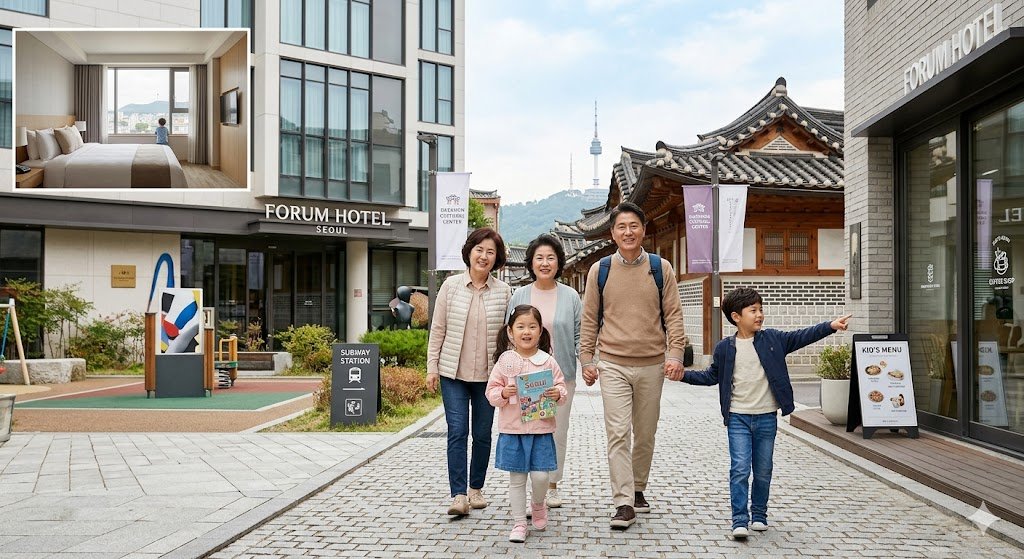
    Family walking through a family-friendly hotel area in Seoul with modern accommodations, traditional hanok-style buildings, and N Seoul Tower in the background.

    Families often look for different things than solo travelers or couples.

    When choosing where to stay in Seoul, parents usually care most about:

    • easy subway access
    • short travel times
    • family-friendly attractions nearby
    • quieter streets at night
    • larger hotel rooms or apartment-style stays
    • easy access to food, convenience stores, and shopping

    That is why the best family area is not always the same as the best area for nightlife or first-time sightseeing.

    If you want a broader overview first, you may also want to read Best Areas to Stay in Seoul for Tourists (2026 Guide) and Types of Accommodation in South Korea: Hotels, Guesthouses, Hanok Stays & More.

    Myeongdong: Best for Convenience

    Myeongdong is one of the most practical areas for families visiting Seoul for the first time.

    It is centrally located, easy to reach from Seoul Station, and well connected to major subway lines. Families staying here can move around the city without too much difficulty.

    Why families choose Myeongdong:

    • central location
    • easy subway access
    • many food options nearby
    • convenient shopping and essentials
    • easy connection to tourist attractions

    Possible downside:

    • the area can feel busy, especially in the evening

    Myeongdong is often best for families who want convenience above all else.

    Jamsil: Best for Families with Children

    Jamsil is one of the strongest choices for families traveling with kids.

    It is home to major attractions such as Lotte World, Lotte World Tower, and Seokchon Lake. The area feels more spacious than some central tourist districts, which many families appreciate.

    Why families choose Jamsil:

    • family-oriented attractions
    • large shopping complexes
    • parks and open space nearby
    • modern hotels and facilities
    • good balance between sightseeing and comfort

    Possible downside:

    • it is farther from some historic central attractions

    Jamsil is often the best area for families who want child-friendly activities close to the hotel.

    Hongdae: Best for Families Who Want Energy and Convenience

    Hongdae is often seen as a younger area, but it can still work well for some families.

    It has strong transport connections, many restaurants, and easy access to the airport rail route. Families with older children may especially like the lively atmosphere.

    Why families choose Hongdae:

    • excellent train connections
    • easy access from the airport
    • many cafes and casual restaurants
    • convenient location for moving around Seoul

    Possible downside:

    • some streets can feel noisy at night

    Hongdae is often better for families with teenagers than for families with very young children.

    Gangnam: Best for Modern Comfort

    Gangnam can be a good choice for families who prefer newer hotels and a more modern atmosphere.

    It is known for large roads, shopping centers, and business districts, but it also has practical advantages for families who want comfort, larger accommodations, and a polished urban environment.

    Why families choose Gangnam:

    • modern hotels
    • upscale and comfortable environment
    • shopping and dining convenience
    • good transport connections

    Possible downside:

    • longer distance from some central tourist sights
    • taxi and hotel costs may be higher

    Gangnam is often best for families who prioritize comfort and hotel quality over budget.

    Insadong or Jongno: Best for Culture-Focused Families

    Families who want a more traditional and cultural stay may prefer Insadong or nearby Jongno.

    These areas are close to palaces, historic streets, museums, and cultural sites. They can be a good match for families who want slower sightseeing and a more classic Seoul atmosphere.

    Why families choose these areas:

    • close to palaces and traditional attractions
    • easier access to cultural sightseeing
    • interesting walking environment
    • good base for history-focused trips

    Possible downside:

    • some accommodations may be smaller or older

    These areas are often best for families who want culture and sightseeing more than shopping or nightlife.

    Which Area Is Best for Different Family Types?

    Best for first-time family trips

    Myeongdong

    Best for families with children – Jamsil

    Best for families with teenagers- Hongdae

    Best for modern hotel comfort- Gangnam

    Best for traditional sightseeing- Insadong or Jongno

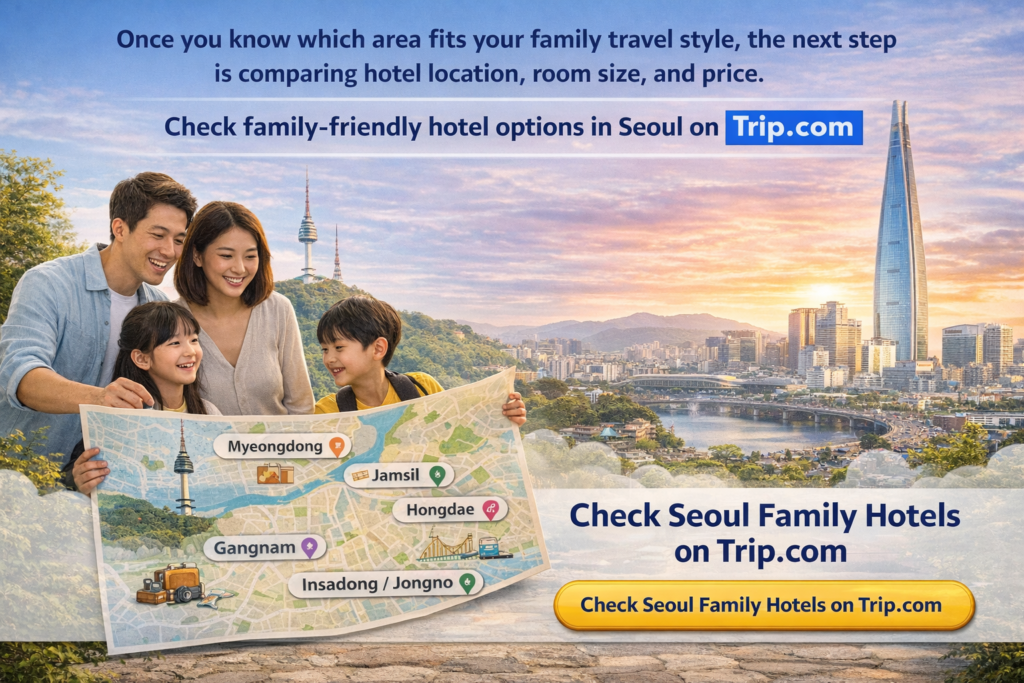
    Once you know which area fits your family travel style, the next step is comparing hotel location, room size, and price.

    Trip.com banner showing a family comparing Seoul hotel areas on a map with a call to check family-friendly hotel options in Seoul

    Check family-friendly hotel options in Seoul on Trip.com.

    Hotel Type Matters Too

    For family trips, the neighborhood is important, but the hotel type matters just as much.

    Families may want to look for:

    • larger rooms
    • family rooms
    • apartment-style stays
    • accommodations with elevators
    • laundry access
    • breakfast options
    • easy street access for strollers or luggage

    Hotel size, family room availability, and overall convenience can vary a lot by district and travel season.
    If you are comparing family-friendly stays in Seoul, it helps to check current prices and room options before booking.

    Family-friendly hotel banner for Seoul featuring parents and children with Seoul landmarks and a Trip.com hotel comparison call to action

    Compare family-friendly hotels in Seoul on Trip.com.

    What If You Have a Lot of Luggage or a Stroller?

    In that case, convenience becomes even more important.

    Families carrying multiple suitcases, strollers, or children’s supplies may find that:

    • direct taxi access matters more
    • hotel location near a station exit becomes more important
    • hilly streets or long walking routes become more stressful

    For that reason, many families do better in areas with simple transport connections and modern hotel access.

    Final Thoughts

    The best place to stay in Seoul for families depends on what kind of trip you want.

    If convenience is your top priority, Myeongdong is often the easiest option. If you are traveling with children, Jamsil is often the most family-friendly. If you want modern comfort, Gangnam can work well, while Insadong and Jongno are better for culture-focused family trips.

    For many families, the best area is the one that reduces daily stress, shortens travel time, and makes it easier to move around with children.

  • How to Get from Seoul Station to Myeongdong, Hongdae, and Gangnam

    How to Get from Seoul Station to Myeongdong, Hongdae, and Gangnam

    Seoul Station is one of the most important transport hubs in South Korea.

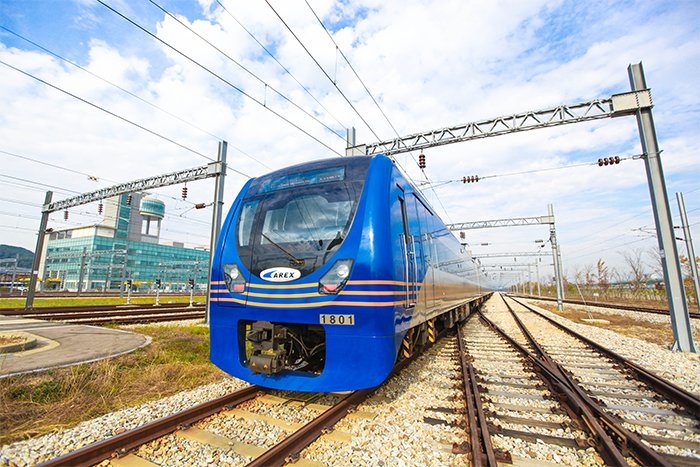
    Many tourists arrive here after taking the AREX train from Incheon International Airport, the KTX from another city, or a long-distance airport bus. Once they reach Seoul Station, the next question is simple: how do you get from there to your hotel area?

    This guide explains the easiest ways to get from Seoul Station to three of the most common tourist areas in Seoul: Myeongdong, Hongdae, and Gangnam.

    Why Seoul Station Matters for Tourists

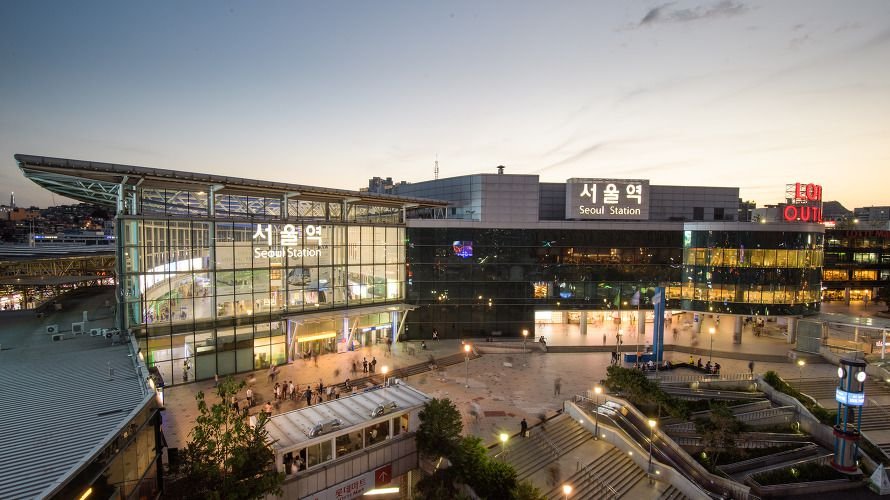
    Exterior view of Seoul Station at dusk with illuminated station signage and surrounding plaza in Seoul, South Korea.

    Seoul Station is often the first major stop many travelers use after arriving in Korea.

    It connects airport trains, long-distance KTX trains, subway lines, taxis, and buses. Because of that, many tourists use Seoul Station as a transfer point before continuing to their hotel.

    To use maps, taxi apps, and translation tools smoothly after arriving at Seoul Station, it helps to have mobile data ready.

    Traveler using Saily mobile data at Seoul Station for maps, taxi apps, and translation tools in South Korea

    Check South Korea eSIM options with Saily.

    If you are still planning your airport arrival route, you may also want to read How to Get from Incheon Airport to Seoul (2026 Guide) and AREX Express vs All-Stop Train: Which Is Better for Tourists?

    How to Get from Seoul Station to Myeongdong

    Myeongdong is one of the easiest tourist areas to reach from Seoul Station.

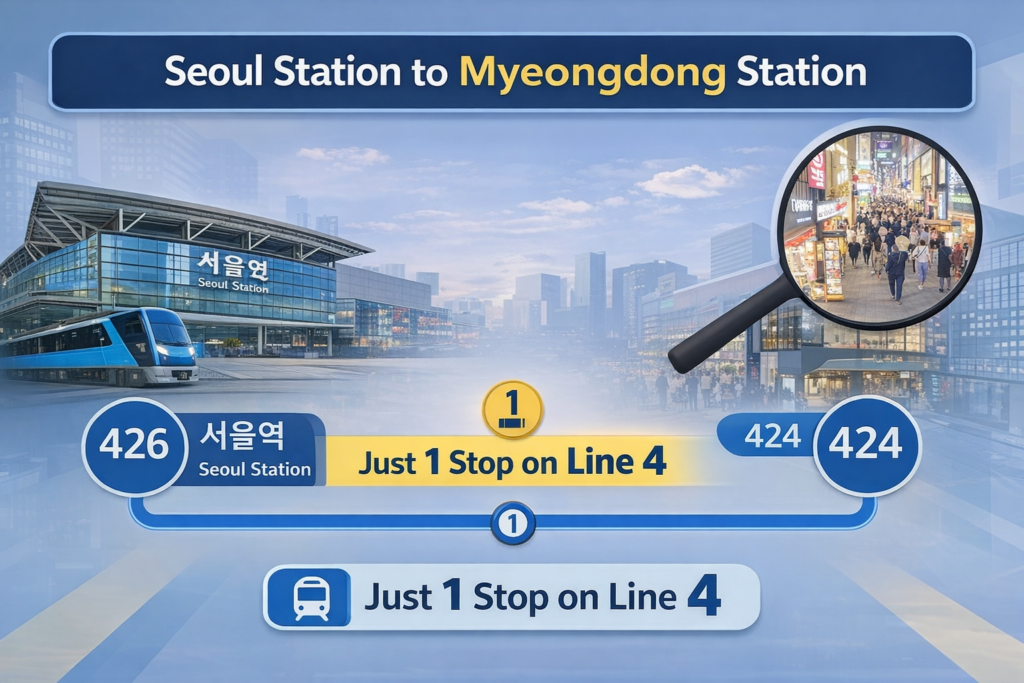
    Infographic showing that Myeongdong Station is just one stop from Seoul Station on Seoul Subway Line 4.

    Option 1: Subway

    The subway is often the most practical choice.

    From Seoul Station, you can take Line 4 and travel one stop to Myeongdong Station. This is a simple and affordable route for most travelers.

    This option is best if:

    • you are traveling light
    • your hotel is close to Myeongdong Station
    • you are comfortable using the subway

    Option 2: Taxi

    A taxi can be convenient if you have large luggage or your hotel is not close to the station exit.

    Because Myeongdong is relatively close to Seoul Station, the ride is usually short. However, traffic can affect travel time depending on the hour.

    This option is best if:

    • you are arriving tired after a long flight
    • you have heavy luggage
    • your hotel is uphill or not easy to reach on foot

    Option 3: Walk

    In some cases, walking can be possible if your luggage is light and your accommodation is near the outer part of Myeongdong.

    However, for most first-time visitors, the subway or a short taxi ride is easier.

    How to Get from Seoul Station to Hongdae

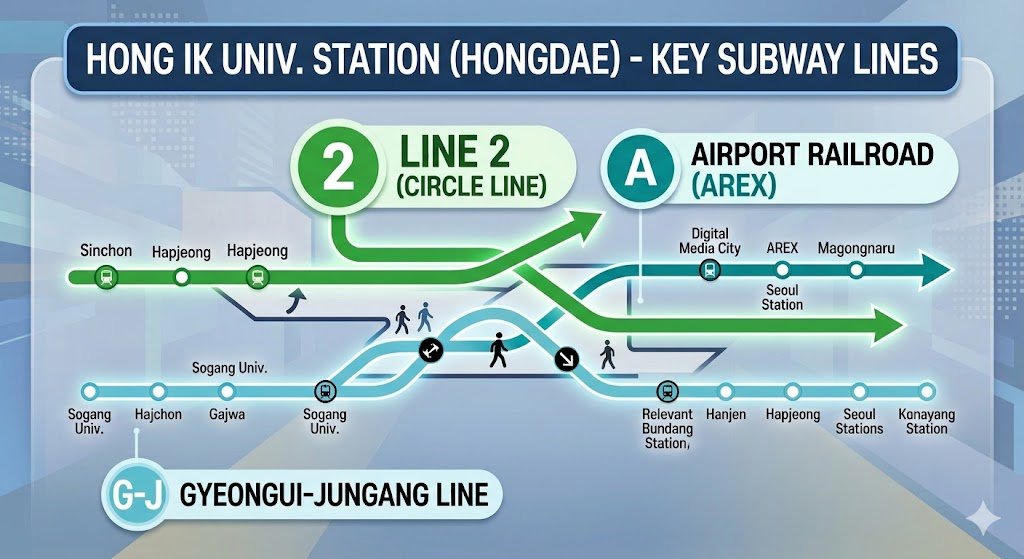
    Infographic showing the subway lines connected to Hongik University Station in Seoul, including Line 2, AREX, and the Gyeongui-Jungang Line.

    Hongdae is another popular area for tourists, especially younger travelers, solo travelers, and visitors interested in nightlife, cafes, and street culture.

    Option 1: AREX or Other Rail Connection

    Hongdae is often easiest to reach by train.

    Because Hongik University Station is a major station on the airport rail route, many travelers find train transfers convenient. Depending on your exact arrival route into Seoul Station, rail can be one of the simplest ways to continue toward Hongdae.

    This option is best if:

    • your hotel is near Hongik University Station
    • you want to avoid road traffic
    • you are comfortable with station transfers

    Option 2: Taxi

    A taxi from Seoul Station to Hongdae is usually straightforward, especially if you are arriving with luggage or traveling in a small group.

    This can be a convenient choice late at night or when you do not want to navigate station exits and transfers.

    If you plan to use taxi apps, maps, or translation tools after arriving in Seoul, having mobile data can make the trip much easier.

    Traveler using Saily eSIM in Hongdae for taxi apps, maps, and translation tools after arriving in Seoul

    Check South Korea eSIM options with Saily.

    This option is best if:

    • you are arriving in the evening
    • you are carrying more luggage
    • you want the most direct route to your hotel

    If you are comparing local taxi options, you may also want to read How to Use Kakao T in Korea as a Tourist, Uber in Korea: What Tourists Need to Know, and How to Use Taxis in Korea (Kakao T, Uber & Tips).

    How to Get from Seoul Station to Gangnam

    Gangnam is farther from Seoul Station than Myeongdong or Hongdae, so the best option depends more on your comfort level, luggage, and the exact location of your hotel.

    Foreign tourist outside Seoul Station deciding between taking the subway or a taxi to Gangnam in Seoul.

    Option 1: Subway

    The subway is usually the most affordable way to reach Gangnam.

    However, the route may require more time and sometimes one or more transfers depending on where in Gangnam you are staying. Since Gangnam is a large district, your exact destination matters a lot.

    This option is best if:

    • you are traveling on a budget
    • you do not mind transfers
    • you are comfortable navigating the subway system

    Option 2: Taxi

    A taxi is often the simplest way to reach Gangnam directly from Seoul Station, especially if you are unfamiliar with Seoul’s subway network.

    Because the distance is longer, the ride will usually cost more than a trip to Myeongdong or Hongdae. Travel time can also change a lot depending on traffic.

    If you are staying in Gangnam, your hotel location can make a big difference in travel time and convenience.

    Trip.com banner showing Gangnam skyline and hotel comparison by location and price for travelers staying in Seoul

    Compare Seoul hotel locations and prices on Trip.com

    This option is best if:

    • you have luggage
    • your hotel is not near a major subway exit
    • you want the easiest door-to-door option

    Which Option Is Best for First-Time Visitors?

    For many first-time visitors, the best option depends on the hotel area.

    Best for Myeongdong

    The subway is usually the easiest choice because the distance is short and the connection is simple.

    Best for Hongdae

    Train or taxi are both practical, depending on how much luggage you have and how close your hotel is to Hongik University Station.

    Best for Gangnam

    A taxi is often easier for first-time visitors, while the subway is better for travelers who want to save money and do not mind a longer route.

    What If You Have Heavy Luggage?

    Luggage changes everything.

    A route that feels easy with a backpack can feel much more stressful with two suitcases. Subway stairs, long station corridors, and crowded train cars can all make arrival feel harder than expected.

    If you are carrying larger luggage, taxis may be worth considering even for shorter routes, especially if:

    • you are arriving during rush hour
    • your hotel is not close to the station
    • you are tired after a long flight
    • you are traveling with children or family

    What About Late-Night Arrivals?

    If you reach Seoul Station late at night, your transport choices may feel different.

    The subway may still work depending on the hour, but many travelers prefer taxis for convenience and peace of mind after dark. This is especially true if they are heading to Hongdae or Gangnam with luggage.

    Late-night arrivals feel much easier when you can use maps, taxi apps, and translation tools right away.

    Saily banner for late-night arrival in Seoul showing taxi, city skyline, and mobile data use for maps, taxi apps, and translation tools

    Check South Korea eSIM options with Saily.

    If your arrival timing is part of your planning, you may also want to read Public Transportation Apps in Korea for Tourists (2026 Guide) and Transportation in Korea: Complete Guide for Tourists.

    Quick Comparison

    Myeongdong

    • easiest by subway
    • short distance from Seoul Station
    • taxi also works well with luggage

    Hongdae

    • train is often convenient
    • taxi is practical for late arrivals or luggage
    • a good option for travelers staying near Hongik University Station

    Gangnam

    • subway is cheaper
    • taxi is simpler
    • better to choose based on luggage, traffic, and hotel location

    Final Thoughts

    Getting from Seoul Station to Myeongdong, Hongdae, and Gangnam is usually not difficult, but the best route depends on your destination, luggage, and comfort with public transportation.

    For Myeongdong, the subway is often the simplest answer. For Hongdae, rail or taxi can both work well. For Gangnam, many travelers choose between a cheaper subway ride and a more convenient taxi ride.

    If you are visiting Seoul for the first time, the easiest route is not always the cheapest one. In many cases, choosing the less stressful option can make your arrival much smoother.

  • AREX Express vs All-Stop Train: Which Is Better for Tourists?

    AREX Express vs All-Stop Train: Which Is Better for Tourists?

    If you are arriving at Incheon International Airport and heading into Seoul, one of the first transport decisions you will make is how to use the AREX train.

    Many travelers are unsure whether they should take the AREX Express Train or the All-Stop Train. Both connect the airport to Seoul, but they are designed for different types of travelers.

    This guide explains the difference between the two, including travel time, cost, convenience, luggage considerations, and which option is usually better depending on your situation.

    What Is AREX?

    AREX stands for Airport Railroad Express.

    It is the rail line that connects Incheon International Airport to Seoul and other stations along the way. For many tourists, it is one of the easiest and most reliable ways to travel from the airport into the city.

    There are two main AREX options:

    • AREX Express Train
    • AREX All-Stop Train

    Although they use the same airport rail corridor, the travel experience is different.

    To use airport maps, train apps, and translation tools smoothly from the moment you land, it helps to have mobile data ready.

    Traveler using Saily eSIM immediately after arriving at Incheon Airport in South Korea

    Check South Korea eSIM options with Saily.

    What Is the AREX Express Train?

    Promotional poster-style image of the AREX Express Train route from Incheon Airport to Seoul Station showing 63 km, 51 minutes, fare information, and a passenger seated inside the train.

    The AREX Express Train is the faster and more direct airport rail option.

    It runs non-stop between Incheon International Airport and Seoul Station, which makes it attractive for travelers who want to reach central Seoul quickly.

    The Express Train is often preferred by tourists who:

    • want the fastest rail option
    • are staying near Seoul Station
    • have luggage and prefer a simpler route
    • do not want multiple intermediate stops

    Because it is a direct service, the ride feels more straightforward and less crowded than some other public transport options.

    👉Book your AREX Express ticket at a discounted rate.

    Klook promotional banner for discounted AREX Express train tickets from Incheon Airport to Seoul Station with the text Save time and money. Book your AREX Express ticket at a discounted rate.

    What Is the AREX All-Stop Train?

    The AREX All-Stop Train is the regular commuter version of the airport rail line.

    Unlike the Express Train, it stops at many stations between the airport and Seoul. This makes it slower, but often more practical for travelers whose destination is not Seoul Station itself.

    The All-Stop Train is often a good choice for tourists who:

    • want a lower-cost option
    • are comfortable using the subway system
    • need to get off at an intermediate station
    • are staying in areas better connected before Seoul Station

    For many budget-conscious travelers, this option offers good value.

    Main Difference Between AREX Express and All-Stop

    The biggest difference is simple:

    • AREX Express is faster and non-stop
    • AREX All-Stop is cheaper and stops at multiple stations

    That means the better choice depends less on the train itself and more on your hotel location, budget, luggage, and comfort with public transport.

    Travel Time Comparison

    The AREX Express Train is usually the faster option because it runs directly to Seoul Station.

    The All-Stop Train takes longer because it stops at many stations along the route.

    In general:

    • AREX Express Train is best if you want speed and simplicity
    • AREX All-Stop Train is best if you do not mind extra travel time in exchange for lower cost or better station flexibility

    If you are arriving after a long international flight, even a small time difference may feel more important than it looks on paper.

    Which Option Is Cheaper?

    The All-Stop Train is usually the cheaper choice.

    This is one of the main reasons many travelers choose it, especially if they are trying to reduce transportation costs on arrival.

    The Express Train, on the other hand, usually costs more because it offers a faster and more direct service.

    Which Option Is Better for Tourists with Luggage?

    For travelers carrying large suitcases, the AREX Express Train is often the easier option.

    Because it is a direct airport service, it tends to feel more comfortable for first-time visitors arriving with luggage. Fewer stops and a more direct journey can make the trip feel less stressful.

    The All-Stop Train can still work well, but it may be less convenient if:

    • the train is crowded
    • you are traveling during rush hour
    • you are not comfortable moving luggage through multiple stations or transfers

    If you are traveling light, the difference may matter less.

    Which Option Is Better for Different Seoul Areas?

    Your hotel location matters more than many travelers expect.

    Best for Seoul Station Area

    If you are staying near Seoul Station or plan to transfer there, the AREX Express Train is often the easiest choice.

    Best for Intermediate Stops

    If your hotel is closer to stations served before Seoul Station, the All-Stop Train may be more practical because you can get off earlier without backtracking.

    If you are still deciding where to stay, compare Seoul hotel locations and prices before booking.

    Trip.com banner showing Seoul skyline and hotel options for comparing Seoul hotel locations and prices

    Compare Seoul hotel locations and prices on Trip.com

    Best for Subway Connections

    If you are already comfortable navigating Seoul’s subway system, the All-Stop Train may feel more efficient overall.

    If you are not yet familiar with train lines in Seoul, you may also want to read Seoul Subway Map Guide (2026) – How Tourists Navigate Seoul Easily and How to Use the Seoul Subway as a Tourist (2026 Guide).

    Which One Is Better for First-Time Visitors?

    For many first-time visitors, the AREX Express Train feels easier.

    The main reason is not only speed. It is also simplicity. After a long flight, many travelers prefer a direct route with fewer stops and less uncertainty.

    However, that does not mean the All-Stop Train is difficult. Many tourists use it without any problem, especially if they are staying near a station on the route or want to save money.

    If you prefer the easiest arrival experience, Express is often the better choice.

    If you prefer flexibility and lower cost, All-Stop may be better.

    When the All-Stop Train Makes More Sense

    The All-Stop Train is often the smarter option if:

    • you are traveling on a budget
    • your destination is not Seoul Station
    • you are comfortable with subway-style travel
    • you want more stop options along the route

    For some travelers, it is not just the cheaper option. It is the more practical one.

    When the Express Train Makes More Sense

    The Express Train is often the smarter option if:

    • you want the fastest rail option into central Seoul
    • you are tired after a long flight
    • you have more luggage
    • you want the most straightforward train experience
    • you are heading directly toward Seoul Station

    For first-time visitors, this option often feels less stressful.

    Final Thoughts

    Both the AREX Express Train and the All-Stop Train are useful options for traveling from Incheon Airport to Seoul.

    The Express Train is usually better for speed, simplicity, and travelers with luggage. The All-Stop Train is usually better for lower cost, more station flexibility, and travelers who are comfortable using local rail transport.

    For most tourists, the best choice comes down to one simple question: do you want the easiest route, or the cheapest practical route?

    If you are still comparing airport transfer options, you may also want to read How to Get from Incheon Airport to Seoul (2026 Guide), Transportation in Korea: Complete Guide for Tourists, and Public Transportation Apps in Korea for Tourists (2026 Guide).

  • Uber in Korea: What Tourists Need to Know

    Uber in Korea: What Tourists Need to Know

    Many travelers assume they can use Uber in South Korea the same way they do in other countries.

    In reality, the experience can be different from what tourists expect. Uber is available in Korea, but local taxi apps such as Kakao T are still much more widely used in daily life.

    This guide explains how Uber works in Korea, whether tourists can use it easily, and what you should know before relying on it during your trip.

    Is Uber Available in Korea?

    Yes, Uber is available in South Korea.

    However, it does not always work in the same way travelers may be used to in places like the United States, Canada, or parts of Europe. In Korea, local taxi platforms are much more common, and many travelers find Kakao T easier to rely on for everyday taxi use.

    That does not mean Uber is useless. Some tourists still prefer Uber because they are already familiar with the app and payment setup.

    Can Tourists Use Uber in Korea?

    Yes, many tourists can use Uber in Korea.

    If you already use Uber in your home country, using it in Korea may feel familiar. In some cases, this can make the first taxi experience less stressful than learning a completely new local app.

    However, availability and convenience may vary depending on the city, time of day, and pickup location. In many situations, Kakao T remains the more common local option.

    Ride-hailing apps, maps, and translation tools work much better when you have mobile data from the moment you arrive.

    Check South Korea eSIM options with Saily →

    Saily South Korea eSIM banner featuring two tourists using a smartphone in Seoul with a taxi, hanok rooftops, and N Seoul Tower in the background

    If you want to compare both services, you may also want to read How to Use Kakao T in Korea as a Tourist and How to Use Taxis in Korea (Kakao T, Uber & Tips).

    Why Some Tourists Prefer Uber

    Some travelers still choose Uber in Korea for a few simple reasons:

    • they already have the app installed
    • their payment method is already connected
    • they are familiar with the interface
    • they want to avoid setting up a new local app
    • they prefer using one transport app across multiple countries

    For tourists who value convenience and familiarity, that can be enough reason to try Uber first.

    How Uber Works in Korea

    In general, Uber in Korea works like this:

    • you open the app
    • enter your pickup point
    • search your destination
    • review the route or vehicle option
    • request the ride
    • meet the driver at the pickup point

    The overall process feels familiar to many international travelers. However, the local transport environment is still different, so flexibility is important.

    Is Uber Better Than Kakao T?

    Usually, Kakao T is the more locally established option in Korea.

    That means many travelers will find that Kakao T is more common in everyday situations, especially in large cities such as Seoul. It is widely used by locals and often feels more integrated into the local taxi environment.

    Uber can still be useful, especially if:

    • you already know the app well
    • you want to avoid setting up another service
    • you prefer your usual payment system
    • you want to compare wait times between apps

    For many tourists, the best approach is not choosing only one app. It is being comfortable with both.

    Where Uber Is Most Useful

    Uber can be useful in situations like these:

    • when you already use Uber internationally
    • when you want a familiar interface
    • when you prefer app-based payment
    • when you want to compare options with Kakao T
    • when you are traveling in a major city

    In smaller cities or less busy areas, local taxi options may still be more practical.

    Can You Pay by Card?

    Many tourists prefer Uber because their card may already be connected to the app.

    That can make payment feel simpler than setting up a local service from scratch. Even so, it is still wise to carry at least one international card that works in Korea.

    You may also want to read How to Pay in South Korea in 2026: Cash, Cards & Best Money Tips.

    What Problems Can Tourists Face?

    Although Uber can be convenient, some travelers may still run into issues such as:

    • limited availability depending on area
    • pickup confusion in busy streets
    • differences from the Uber experience in other countries
    • difficulty finding the exact pickup location
    • longer waits during peak hours

    For this reason, it is smart not to rely on only one taxi option during your trip.

    Should You Download Both Uber and Kakao T?

    Yes, for many tourists this is the best approach.

    Having both apps gives you more flexibility. If one app has fewer cars available, a longer wait time, or a confusing pickup situation, you can try the other.

    This is especially useful in Seoul, where traffic, nightlife districts, and crowded pickup points can make transport decisions less predictable.

    If you are still planning your local transportation, you may also want to read Public Transportation Apps in Korea for Tourists (2026 Guide), Transportation in Korea: Complete Guide for Tourists, and Seoul Subway Map Guide (2026) – How Tourists Navigate Seoul Easily.

    Final Thoughts

    Uber can be useful in South Korea, especially for travelers who already know the app and want a familiar way to request a ride.

    However, it is important to understand that Uber is not always the main taxi app tourists will rely on in Korea. In many situations, Kakao T remains the more common and practical option.

    For most first-time visitors, the smartest choice is simple: install both, stay flexible, and use whichever service is easier in the moment.

  • How to Use Kakao T in Korea as a Tourist

    How to Use Kakao T in Korea as a Tourist

    Getting a taxi in South Korea is usually easy, but many travelers feel confused the first time they try to use a local taxi app.

    Kakao T is the most widely used taxi app in Korea, and it can make travel much easier for tourists in Seoul and other major cities. Instead of waiting on the street and trying to explain your destination, you can search your destination in the app and request a ride directly.

    This guide explains how Kakao T works for tourists, whether foreigners can use it, and what to expect before you book your first ride.

    What Is Kakao T?

    Kakao Taxi logo illustration with a cartoon driver wearing sunglasses above a yellow taxi sign.

    Kakao T is Korea’s most popular mobility app.

    It is commonly used to book taxis, and in some cases it also offers other transport-related services. For most tourists, however, the main purpose of Kakao T is simple: it helps you call a taxi more easily than hailing one on the street.

    In large cities such as Seoul, Busan, and Incheon, many locals rely on Kakao T every day.

    Can Tourists Use Kakao T in Korea?

    Yes, many tourists can use Kakao T in Korea.
    However, the experience may vary depending on your account setup, payment method, app version, and language settings. Some travelers find Kakao T easy to use, while others may find k.ride easier for a short trip because it was designed for international visitors and supports overseas card registration.

    In general, Kakao T is most useful if:

    • you have mobile internet in Korea
    • you can search destinations using English or Korean
    • you want to avoid explaining directions in person
    • you are traveling in a large city where taxis are easy to find

    Taxi apps, navigation apps, and translation tools work much better when you have mobile data from the moment you arrive.

    Check South Korea eSIM options with Saily →

    A promotional banner showing the seamless integration of Saily eSIM and Kakao T Taxi services for tourists in Seoul, featuring a Kakao T taxi, a traveler using a smartphone, and iconic Seoul landmarks like N Seoul Tower and a traditional Hanok.

    If you are still preparing your phone setup, you may also want to read SIM vs eSIM for South Korea in 2026: Which One Should You Choose? and Do You Need an eSIM for South Korea in 2026? (Best Options Explained).

    Why Tourists Use Kakao T

    Many travelers use Kakao T because it is more convenient than standing on the street and trying to flag down a taxi.

    Common benefits include:

    • easier pickup requests in busy areas
    • destination input inside the app
    • less language stress
    • more convenience late at night or in bad weather
    • better control over pickup location

    For many first-time visitors, Kakao T feels easier than trying to explain an address directly to a driver.

    How to Use Kakao T Step by Step

    Download the App

    Install Kakao T on your phone before or after arriving in Korea.

    If possible, it is a good idea to install it before your trip so you can get familiar with the layout in advance.

    Set the Language

    Depending on your version of the app and phone settings, English support may be available. If the interface still feels confusing, many travelers use screenshots, hotel business cards, or map apps to help confirm the destination.

    Enter Your Pickup Location

    The app usually detects your current location, but you should always check it carefully.

    In dense areas of Seoul, the pickup point may not be exact. It is better to stand somewhere safe and easy for the driver to find, such as near a main road, building entrance, or convenience store.

    Search Your Destination

    Enter your destination directly in the app.

    Popular tourist places, hotels, stations, and landmarks are often easier to find than full street addresses. If needed, copy the name from a map app.

    💡 Quick Tip for K-Beauty Lovers: For example, if you are heading to a popular skin clinic like Lienjang Gangnam, simply search for “Lienjang Gangnam” in English. It is one of the most visited spots by international travelers!

    👉 [Check Prices & Book Lienjang Gangnam Here]

    A tourist using Kakao T app inside a taxi to visit Lienjang Gangnam skin clinic in Seoul, South Korea.

    Choose the Taxi Type

    Depending on the area and time, you may see different taxi options.

    In many cases, tourists simply choose the standard option. Premium or larger taxi types may cost more.

    Orange standard Kakao taxi and white Kakao Taxi van parked side by side on a wet city street in South Korea.

    Confirm the Ride Request

    Once the route and pickup point look correct, request the taxi.

    At busy hours, you may need to wait longer or try again.

    Meet the Driver

    After the taxi is assigned, check the car information and move to the pickup point shown in the app.

    Make sure the license plate and vehicle match what you see in the app before getting in.

    Do You Need a Korean Phone Number?

    Not always, but setup can feel easier or harder depending on your account and verification flow.
    Some travelers use Kakao T without major issues, while others run into setup or payment limitations. If Kakao T feels difficult to use, k.ride may be a simpler option for short-term visitors, and regular street taxis are still easy to find in many tourist areas.

    Can You Pay by Card?

    In Korea, many taxis accept credit cards, and payment options can vary depending on how you book the ride.
    Some travelers prefer to pay the driver directly in the taxi, while others use in-app payment. If you want a simpler setup as a short-term visitor, k.ride may be easier because it supports overseas card registration. It is still smart to carry at least one international card that works in Korea.

    You may also want to read How to Pay in South Korea in 2026: Cash, Cards & Best Money Tips.

    When Kakao T Is Most Useful

    Kakao T is especially useful in situations like these:

    • late at night when street taxis are harder to find
    • rainy weather
    • travel with luggage
    • pickup from hotels, stations, or tourist attractions
    • travel in unfamiliar neighborhoods

    If you want an easier airport arrival before using taxi apps in the city, many travelers also book an airport transfer or AREX train in advance.

    Check airport transfer and AREX options on Klook →

    A professional Klook promotional banner for AREX Airport Express Train tickets in Seoul, featuring a modern express train, a traveler using a smartphone, and a 'Pre-book AREX Tickets' call to action with a background of N Seoul Tower and a traditional Hanok.

    It can also be helpful when returning to your hotel after visiting nightlife areas or popular districts.

    If you are still comparing transport options, read Transportation in Korea: Complete Guide for Tourists and Public Transportation Apps in Korea for Tourists (2026 Guide).

    For travelers who want a more visitor-friendly setup, it may also be worth comparing Kakao T with k.ride. Kakao T is still the best-known taxi app in Korea, but some international travelers may find k.ride easier to use.

    Tips for Tourists Using Kakao T

    • Check the pickup point carefully
    • Stand somewhere visible and safe
    • Use a landmark if the exact address is difficult
    • Keep mobile data active while waiting
    • Have your destination written in English or Korean if needed
    • Allow extra time during rush hour or late at night
    • Save a screenshot of your hotel name and address in Korean
    • Check the estimated fare in the app when available

    Is Kakao T Better Than Hailing a Taxi?

    It depends on the situation.

    Hailing a taxi on the street is still possible in many parts of Seoul, especially during the day. However, Kakao T can be more convenient when:

    • you do not speak Korean
    • you are in a crowded area
    • you want to avoid showing the address manually
    • you are traveling late at night

    For many tourists, the best approach is to be comfortable with both options.

    Common Problems Tourists May Face

    Some travelers run into small issues when using Kakao T for the first time.

    These can include:

    • difficulty finding the exact pickup point
    • trouble searching a destination
    • payment setup confusion
    • longer waits during peak hours
    • app interface differences depending on device or language settings

    These issues are usually manageable, but it is good to stay flexible.

    If Kakao T does not work smoothly, you can still use regular taxis, ask hotel staff for help, move to a clearer pickup point on a main road, or try k.ride instead.

    If you need general travel assistance in Korea,call 1330, the Korea Travel Helpline. In Seoul, taxi-related complaints or local service issues can also be reported through 120 ,the Dasan Call Center.

    Final Thoughts

    Kakao T is one of the most useful taxi apps for travelers in South Korea.

    For many tourists, it makes taxi travel easier, especially in large cities like Seoul where busy streets, language differences, and complex pickup points can make regular taxi use feel stressful.

    It may take a little practice at first, but once you understand how pickup points and destination search work, Kakao T can become one of the most convenient transport apps during your trip.

    If you are planning the rest of your local transportation, you may also want to read Public Transportation Apps in Korea for Tourists (2026 Guide), Seoul Subway Map Guide (2026) – How Tourists Navigate Seoul Easily, and How to Get from Incheon Airport to Seoul (2026 Guide).

    Some short-term international visitors may also find k.ride easier for payment and setup, so it can be helpful to know both options before your trip.