Tag: Jobs in Korea

  • Where to Find Jobs in Korea for Foreigners: Best Websites and Apps

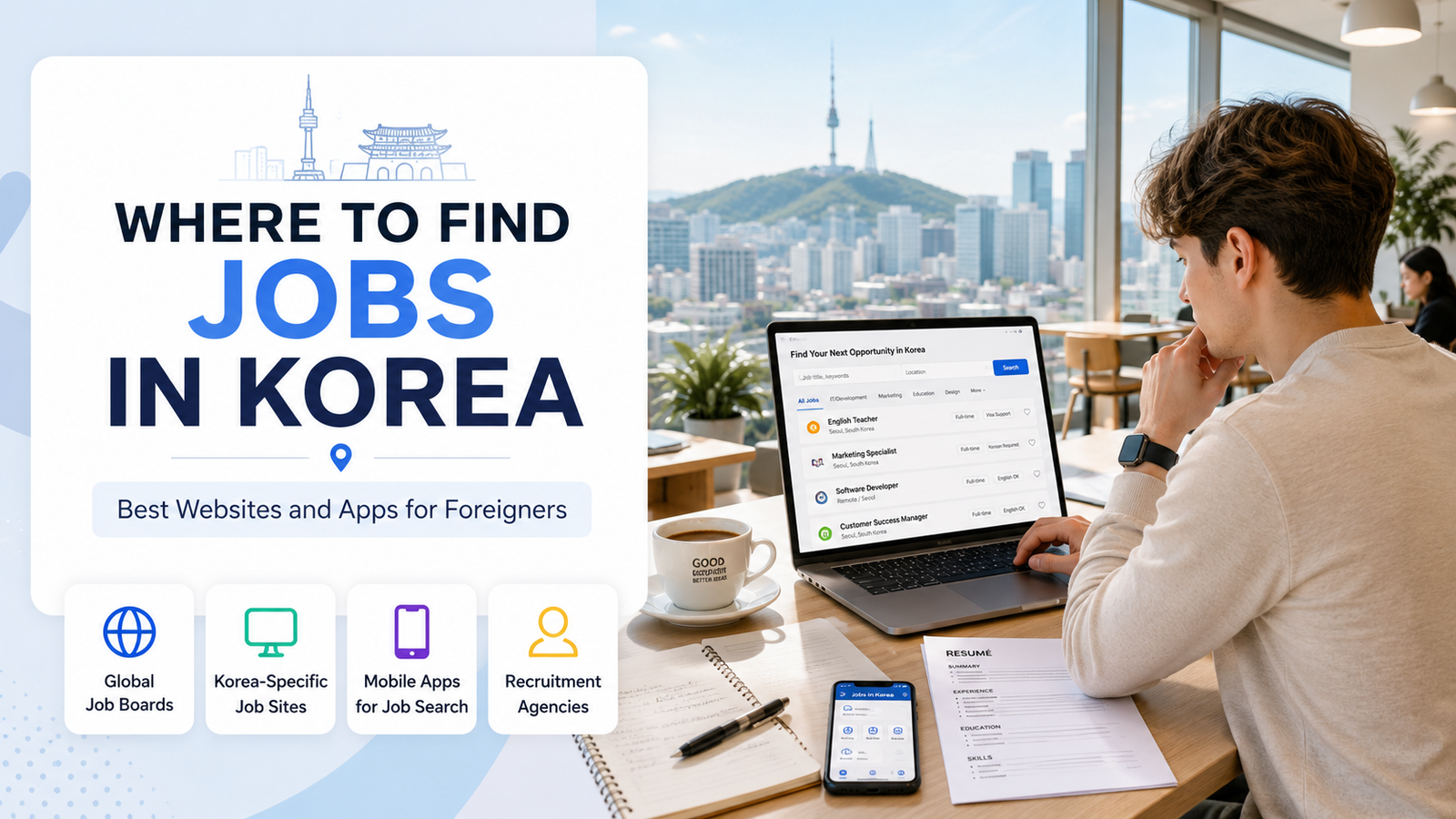
    Where to Find Jobs in Korea for Foreigners: Best Websites and Apps

    Finding a job in Korea as a foreigner can feel confusing at first. There are many websites, apps, school job boards, recruiter posts, Facebook groups, and company career pages, but not every listing is suitable for your visa, Korean level, schedule, or experience.

    Some platforms are better for part-time jobs. Others are better for full-time office roles, teaching jobs, internships, startup jobs, or international company positions. The most important point is not simply where to search, but how to check whether a job is legitimate and whether you are legally allowed to do it.

    Important Notice: This article provides general information only. KoreaReadyGuide does not provide legal advice, immigration advice, job placement, visa sponsorship, or employment guarantees. Job availability, visa rules, and application requirements can change. Always confirm your eligibility with HiKorea, your school, your employer, or the Immigration Contact Center before accepting or starting any job in South Korea.

    Start With Your Visa Status First

    Before opening job websites or sending applications, check your visa status.

    Your visa determines what kind of work you may be allowed to do in Korea. A job that is legal for one foreigner may not be legal for another foreigner.

    For example, international students on D-2 or D-4 visas may need separate permission before working part-time. Working holiday visa holders, F-series visa holders, E-series visa holders, job-seeking visa holders, and permanent residents may have different conditions.

    Before applying, ask yourself:

    • What visa do I currently hold?
    • Am I allowed to work in Korea?
    • Do I need permission before starting?
    • Can I work part-time, full-time, or only in a specific field?
    • Can I change employers freely?
    • Is this job category allowed under my status?
    • Does the employer need to sponsor, register, or report anything?

    International students should review the permission process carefully before applying. Our D-2 and D-4 student part-time work permission guide explains the basic steps, documents, school confirmation, and approval process.

    Do not rely only on a job post that says “foreigners welcome.” That phrase does not automatically mean the job is legal for your visa.

    Best Job Websites and Apps in Korea: Quick Comparison

    Platform or sourceBest forKorean levelGood for foreigners?Main caution
    JobKoreaOffice jobs, companies, internshipsIntermediate to advancedUseful for career jobsMany listings are written for Korean applicants
    SaraminProfessional roles, office jobs, internshipsIntermediate to advancedUseful for serious job seekersKorean-style résumé may be expected
    AlbamonPart-time jobs and hourly workBasic to intermediateUseful for local part-time jobsCheck visa permission before applying
    AlbaCheongukPart-time jobs and local hourly workBasic to intermediateUseful for cafés, restaurants, storesSome employers may not know foreigner visa rules
    Craigslist SeoulEnglish-language job posts and gigsBasic to advancedEasy to browse in EnglishScam checks are essential
    LinkedInInternational companies and professional rolesIntermediate to advancedStrong for office jobsFewer local part-time listings
    School job boardsCampus jobs and student noticesBasic to intermediateVery useful for studentsImmigration permission may still be required
    Company career pagesDirect applicationsIntermediate to advancedGood for serious applicantsTakes more research
    Facebook groupsCommunity job leadsBasic to advancedHelpful but informalHigher scam risk
    RecruitersProfessional or specialized rolesIntermediate to advancedUseful for experienced workersAvoid recruiters asking applicants for fees

    Use more than one source. In Korea, some jobs appear only on Korean platforms, while others appear through schools, recruiters, company websites, or foreigner communities.

    Reliable mobile data is also useful when using Korean job apps, checking interview locations, receiving employer messages, or translating job posts on the go. Foreigners with an eSIM-compatible phone can compare Klook’s South Korea eSIM plans before choosing a mobile data option.

    1. JobKorea

    JobKorea is one of Korea’s major job search platforms. It is commonly used for company hiring, office jobs, internships, career positions, and some part-time opportunities.

    It can be useful if you are looking for:

    • Korean company jobs
    • Office assistant roles
    • Marketing positions
    • Sales support
    • IT and startup jobs
    • Internships
    • Entry-level roles
    • Foreign-language customer support
    • Global business positions

    The main challenge is language. Many listings are written in Korean and assume that applicants understand Korean workplace terms, résumé formats, and application procedures.

    Useful Korean search terms include:

    • 외국인 채용 — hiring foreigners
    • 영어 가능자 — English speaker
    • 외국어 가능자 — foreign language speaker
    • 인턴 — intern
    • 아르바이트 — part-time job
    • 계약직 — contract worker
    • 신입 — entry-level
    • 경력 — experienced

    Before applying, check whether the employer clearly mentions visa support, foreigner eligibility, language requirements, job duties, location, and employment type.

    2. Saramin

    Saramin is another major Korean job search site. It is especially useful for professional roles, office jobs, internships, and career-track employment.

    Foreigners may find opportunities in:

    • Overseas sales
    • Global marketing
    • Translation support
    • Customer service
    • IT and software
    • Content localization
    • International trade
    • Business development
    • Education-related companies

    Saramin can be useful if you already have a Korean résumé or can prepare one. Many employers expect applicants to submit a Korean-style résumé with education, work history, skills, language ability, and sometimes a self-introduction letter.

    Useful Korean keywords include:

    • 해외영업 — overseas sales
    • 글로벌 마케팅 — global marketing
    • 번역 — translation
    • 통역 — interpretation
    • 외국인 가능 — foreigners possible
    • 비자 지원 — visa support
    • 영어권 — English-speaking region
    • 콘텐츠 — content

    Saramin is generally better for serious career applications than quick hourly work.

    3. Albamon

    Albamon is one of the most commonly used platforms for part-time jobs in Korea.

    It is useful for finding local hourly jobs such as:

    • Café work
    • Restaurant work
    • Convenience store jobs
    • Retail shops
    • Event staff
    • Kitchen assistant roles
    • Cleaning or facility support
    • Short-term promotional jobs

    For students and foreigners looking for part-time work, Albamon can be helpful because many listings are location-based and shift-based.

    However, students should be careful. A job that looks simple may still require immigration permission. Some employers may not fully understand D-2 or D-4 student work rules.

    Before applying, check:

    • Workplace address
    • Hourly wage
    • Working days
    • Shift times
    • Duties
    • Employer name
    • Business type
    • Whether the employer can provide documents
    • Whether the job is allowed under your visa

    Avoid starting immediately just because the employer says, “It is okay.” Confirm your visa conditions first.

    4. AlbaCheonguk

    AlbaCheonguk is another major part-time job platform in Korea. Like Albamon, it is commonly used for hourly jobs and local work.

    It may be useful for:

    • Restaurant jobs
    • Store jobs
    • Café jobs
    • Short-term event jobs
    • Weekend jobs
    • Evening jobs
    • Local neighborhood work

    For foreigners, the advantage is that it provides many listings. The disadvantage is that many posts are written mainly for Korean applicants.

    Useful filters may include location, working hours, pay, job category, and employment type.

    When reviewing a listing, do not focus only on the hourly wage. Also check whether the job requires heavy customer communication, late-night work, food handling, physical labor, or cash register responsibility.

    5. Craigslist Seoul

    Craigslist Seoul is one of the easier English-language platforms for foreigners to browse.

    You may find posts related to:

    • English teaching
    • Tutoring
    • Editing
    • Modeling
    • Voice recording
    • Translation
    • Short-term gigs
    • Startup support
    • International community jobs

    The advantage is that many posts are in English. The disadvantage is that quality varies greatly.

    Be careful with listings that:

    • Offer unusually high pay
    • Ask for personal documents too early
    • Do not show a company name
    • Provide only a personal messaging account
    • Ask for unpaid trial work
    • Promise visa sponsorship without details
    • Ask for money or fees
    • Involve adult entertainment or suspicious modeling work
    • Ask you to work before checking your visa

    Craigslist can be useful, but it requires careful screening.

    6. LinkedIn

    LinkedIn is better for professional and international jobs than for local part-time work.

    It is especially useful for foreigners looking for:

    • Global company roles
    • Startup jobs
    • Marketing positions
    • IT jobs
    • Business development roles
    • International sales
    • Recruiting
    • Customer success
    • Content localization
    • Office roles using English or another foreign language

    Many Korean companies use Korean job platforms first, but international companies in Seoul may also post on LinkedIn.

    To improve your chances, prepare an English profile and, when possible, a Korean résumé. Make sure your profile clearly shows:

    • Visa status or work authorization, when appropriate
    • Korean language level
    • English or other language ability
    • Relevant experience
    • Software skills
    • Portfolio or work samples
    • Availability date

    Do not write that you are legally eligible to work unless you are sure.

    7. School Job Boards and International Offices

    For international students, the school may be one of the safest starting points.

    Universities and language institutes may share:

    • Campus assistant jobs
    • Department assistant roles
    • Library work
    • Research support
    • Event staff roles
    • Internship notices
    • Career fair information
    • Company recruitment sessions
    • Part-time work guidance
    • Immigration document instructions

    The biggest advantage is that the school can often explain whether you need permission and what documents you need.

    However, a school notice does not automatically mean every student can work. Your visa category, attendance, grades, Korean level, and employment conditions may still matter.

    Before accepting any job, ask your international office:

    • Is this job allowed for my visa?
    • Do I need permission before starting?
    • Can the school provide confirmation?
    • Does the employer need to submit documents?
    • How many hours can I work?
    • What happens if I change jobs?

    8. Facebook Groups and Expat Communities

    Facebook groups and expat communities can be helpful for finding informal job leads, especially in Seoul, Busan, Daegu, Daejeon, Incheon, and other major areas.

    You may see posts for:

    • English teaching
    • Café work
    • Restaurant work
    • Event staff
    • Modeling
    • Translation
    • Voice recording
    • Babysitting
    • Tutoring
    • Short-term projects

    Community referrals can be useful because other foreigners may share real experiences. But informal groups also carry a higher risk of scams, illegal work, and unclear payment arrangements.

    Never assume a job is legal just because another foreigner did it.

    Before responding to a community post, ask for:

    • Company name
    • Workplace address
    • Exact duties
    • Hourly wage
    • Working schedule
    • Contract details
    • Payment date
    • Visa requirements
    • Business registration information
    • Contact person’s full name

    If the employer avoids basic questions, move on.

    9. Company Career Pages

    For full-time or career-track roles, applying directly through a company’s career page can be more reliable than using only job boards.

    This is especially useful for:

    • Large Korean companies
    • Global companies in Korea
    • Startups
    • Hotels
    • Airlines
    • Education companies
    • Tech companies
    • Entertainment companies
    • Tourism companies
    • International trade companies

    Direct applications can take longer, but they often provide clearer information about the company, department, job duties, and hiring process.

    Search combinations like:

    • Company name + careers
    • Company name + 채용
    • Company name + foreigner
    • Company name + global hiring
    • Company name + internship Korea

    Before applying, check whether the position requires native Korean, Korean citizenship, specific visas, professional licenses, or prior experience in Korea.

    10. Recruiters and Headhunters

    Recruiters can be useful for experienced professionals, bilingual candidates, and foreigners with specialized skills.

    They may help with:

    • Tech jobs
    • Finance jobs
    • Marketing jobs
    • Sales roles
    • Executive positions
    • Bilingual roles
    • Global business roles
    • International company hiring

    However, be careful with recruiters who promise too much.

    A legitimate recruiter should not ask you to pay a fee for a normal job application. They should also be able to explain the employer, role, salary range, hiring process, and visa expectations clearly.

    Ask recruiters:

    • Which company is hiring?
    • Is the role full-time, contract, or freelance?
    • Is visa sponsorship available?
    • What is the salary range?
    • What language level is required?
    • What documents are needed?
    • Will my résumé be shared only with my permission?

    Do not send your passport or Residence Card to unknown recruiters before verifying the company.

    Useful Korean Keywords for Job Searching

    Knowing the right Korean keywords can make job searching much easier.

    English meaningKorean keyword
    Part-time job아르바이트 / 알바
    Foreigner hiring외국인 채용
    Foreigners possible외국인 가능
    English speaker영어 가능자
    Native English speaker원어민
    Translation번역
    Interpretation통역
    Café카페
    Restaurant음식점 / 식당
    Convenience store편의점
    Event staff행사 스태프
    Internship인턴
    Entry-level신입
    Experienced경력
    Contract worker계약직
    Full-time employee정규직
    Visa support비자 지원
    Weekend work주말 근무
    Evening shift야간 근무
    Hourly wage시급
    Work location근무지
    Work hours근무시간

    Try combining keywords with your city or district.

    Examples:

    홍대 카페 알바
    강남 영어 가능자 알바
    서울 외국인 채용
    부산 외국어 가능자
    대구 행사 스태프
    인턴 외국인 가능

    How to Read a Korean Job Post

    A Korean job post may include many terms that are unfamiliar to foreigners. Before applying, check the following sections carefully.

    Look for:

    • 회사명 — company name
    • 근무지 — workplace location
    • 모집직종 — job category
    • 담당업무 — duties
    • 자격요건 — qualifications
    • 우대사항 — preferred qualifications
    • 근무시간 — working hours
    • 근무요일 — working days
    • 급여 — pay
    • 시급 — hourly wage
    • 월급 — monthly salary
    • 계약기간 — contract period
    • 제출서류 — required documents
    • 접수방법 — application method
    • 마감일 — deadline

    Pay close attention to the duties section. Immigration permission usually depends not only on the company, but also on what you will actually do.

    How to Check Whether a Job Is Safe

    A safe job should be clear, documented, and verifiable.

    Before accepting, check:

    • Does the company have a real name?
    • Is the workplace address clear?
    • Are the duties written clearly?
    • Is the wage stated?
    • Are working hours explained?
    • Will you receive a written contract?
    • Can the employer provide documents for immigration if needed?
    • Is the payment method clear?
    • Is the job category allowed for your visa?
    • Does the employer pressure you to start immediately?

    A good employer should understand that foreigners may need time to check visa conditions.

    Warning Signs of a Bad Job Listing

    Avoid or investigate carefully if you see:

    • “No visa problem” without explanation
    • “Start today” pressure
    • No company name
    • No workplace address
    • Cash-only payment
    • No written contract
    • Very high pay for very simple work
    • Requests for passport photos before explaining the job
    • Requests to use someone else’s bank account
    • Unclear duties
    • Adult entertainment-related work
    • Commission-only pay
    • Unpaid trial shifts
    • Recruiter fees
    • Fake visa sponsorship promises
    • Messages only through anonymous chat apps

    If something feels rushed, unclear, or too good to be true, pause before sending personal information.

    Documents You May Need When Applying

    Documents vary depending on the job, visa, employer, and immigration rules.

    You may need:

    • Résumé
    • Cover letter
    • Portfolio
    • Passport copy
    • Residence Card copy
    • Certificate of enrollment
    • Academic transcript
    • Attendance record
    • Employment contract
    • Employer business registration certificate
    • School confirmation form
    • Korean language certificate, when applicable
    • Bank account information for wage payment

    Do not send sensitive documents to unknown individuals before verifying the employer.

    English Résumé vs Korean Résumé

    Foreigners often need both an English résumé and a Korean-style résumé.

    An English résumé is useful for:

    • International companies
    • LinkedIn jobs
    • English teaching roles
    • Global startups
    • Foreign-language positions

    A Korean résumé may be useful for:

    • Korean job platforms
    • Local companies
    • Part-time jobs
    • Office support roles
    • Internships
    • Korean-speaking workplaces

    A Korean résumé may include:

    • Name
    • Contact information
    • Education
    • Work experience
    • Language skills
    • Computer skills
    • Certificates
    • Self-introduction
    • Availability
    • Visa status, when appropriate

    Keep your résumé honest. Do not exaggerate your Korean level, work authorization, degree, or previous experience.

    Should You Apply in Korean or English?

    Use the language of the job post as your guide.

    If the job post is in Korean, apply in Korean unless the employer requests English. If the job post is in English, an English résumé may be acceptable.

    For bilingual roles, you may prepare both.

    A simple message in Korean can help:

    안녕하세요. 채용 공고를 보고 연락드립니다.
    저는 현재 한국에 거주 중인 외국인 지원자입니다.
    비자 조건을 확인한 후 근무 가능 여부를 상담드리고 싶습니다.
    이력서를 보내드려도 될까요?

    English meaning:

    Hello, I am contacting you after seeing your job posting.
    I am a foreign applicant currently living in Korea.
    I would like to check whether the job is possible under my visa conditions.
    May I send my résumé?

    Best Strategy for International Students

    International students should start with their school before using public job apps.

    If you are still deciding what type of work may fit your schedule and Korean level, read our guide to the best part-time jobs in Korea for international students.

    A good search order is:

    1. Ask your international office about work permission.
    2. Check school job boards.
    3. Search for campus or nearby jobs.
    4. Use Albamon or AlbaCheonguk carefully.
    5. Confirm the employer can provide documents.
    6. Apply for permission if required.
    7. Wait for approval before starting work.

    This approach reduces the risk of accepting a job that later causes immigration problems.

    Students should also remember that a short-term job, event job, paid training, trial shift, or freelance project may still count as employment. When in doubt, ask your school or immigration office before participating.

    Best Strategy for Full-Time Job Seekers

    Full-time job seekers should focus on platforms and employers that match their visa and career path.

    A good search order is:

    1. Prepare an English résumé and Korean résumé.
    2. Update LinkedIn.
    3. Search JobKorea and Saramin.
    4. Check company career pages.
    5. Contact reputable recruiters.
    6. Look for roles that mention visa support or foreign-language ability.
    7. Track every application in a spreadsheet.
    8. Prepare for Korean-style interviews.

    For professional jobs, Korean ability can make a major difference, even when the role uses English.

    Best Strategy for English Teachers

    English teaching jobs are common, but they have strict visa and qualification requirements.

    Search sources may include:

    • Recruiter websites
    • School websites
    • Hagwon job boards
    • Craigslist Seoul
    • Facebook groups
    • LinkedIn
    • Direct applications to schools

    Before accepting a teaching job, confirm:

    • Visa type
    • Degree requirements
    • Criminal record check requirements
    • Contract length
    • Housing conditions
    • Teaching hours
    • Prep time
    • Vacation
    • Pension and insurance
    • Severance pay
    • Workplace location
    • Employer reputation

    Teaching without the correct visa or permission can create serious immigration issues.

    When job searching in Korea, you may need to travel to interviews, school offices, company locations, or immigration-related appointments. New arrivals who do not yet have a transportation card can check the Klook T-Money Card options for South Korea before planning their commute.

    How to Organize Your Job Search

    It is easy to lose track of job applications, especially when using several websites at the same time.

    Create a simple spreadsheet with:

    • Company name
    • Platform where you found the job
    • Job title
    • Workplace location
    • Contact person
    • Date applied
    • Required documents
    • Visa or permission status
    • Interview date
    • Follow-up status
    • Notes about risks or concerns

    This helps you avoid sending the same application twice and makes it easier to compare offers.

    Final Checklist Before Applying

    Before you apply to a job in Korea, confirm:

    • Your visa status
    • Whether work is allowed
    • Whether permission is required
    • Whether the job category is permitted
    • The employer’s real name
    • Workplace address
    • Exact duties
    • Wage and payment date
    • Working hours
    • Contract period
    • Required documents
    • Whether the employer can support the process
    • Whether the job post looks safe
    • Whether the schedule fits your life in Korea

    Good job searching in Korea is not just about applying quickly. It is about applying safely.

    Final Thoughts

    There are many places to find jobs in Korea for foreigners, including JobKorea, Saramin, Albamon, AlbaCheonguk, Craigslist Seoul, LinkedIn, school job boards, company career pages, recruiters, and community groups.

    Each platform has a different purpose. Part-time job seekers may use Albamon or AlbaCheonguk. Professional applicants may focus on JobKorea, Saramin, LinkedIn, and company career pages. Students should begin with their school and immigration requirements before accepting any job.

    The best job is not simply the one that replies first. It should be legal for your visa, clearly documented, realistic for your Korean level, and safe for your long-term stay in Korea.

    Important Notice: KoreaReadyGuide does not recruit workers, arrange employment, sponsor visas, or determine individual eligibility. Always verify your current work rights through HiKorea, the Immigration Contact Center at 1345, your school, or the relevant immigration office before accepting or starting any job.
  • How to Get Part-Time Work Permission in Korea: D-2 and D-4 Student Visa Guide

    How to Get Part-Time Work Permission in Korea: D-2 and D-4 Student Visa Guide

    International students often want to work part-time while studying in South Korea. A part-time job can help with living expenses, provide practical experience, and improve Korean language skills.

    However, holding a D-2 or D-4 visa does not automatically mean that you can begin working. In many cases, international students must receive part-time work permission before starting a job.

    Important Notice: This article provides general information only. KoreaReadyGuide does not provide legal advice, immigration advice, job placement, visa sponsorship, or employment guarantees. Eligibility and working conditions can vary depending on your visa subtype, school, academic status, Korean proficiency, job category, and current immigration policy. Always confirm the latest requirements with HiKorea, your school, or the immigration office.

    Do D-2 and D-4 Visa Holders Need Work Permission?

    Students with D-2 or D-4 visas generally need authorization before working outside their school or educational institution.

    The D-2 visa is mainly issued to students enrolled in degree programs, while the D-4 visa is commonly used for Korean language training and certain non-degree programs. Because the primary purpose of these visas is education, employment is treated as an additional activity that may require approval.

    Do not assume that you can work simply because:

    • You have an Alien Registration Card or Residence Card
    • Your employer has hired foreign students before
    • The job requires only a few hours per week
    • You will be paid in cash
    • Another student is doing the same type of work
    • The employer says that immigration permission is unnecessary

    If authorization is required, you should receive it before your first working day.

    Who May Be Eligible?

    Eligibility depends on your individual circumstances. Immigration authorities and your school may consider factors such as:

    • Your visa type and visa subtype
    • How long you have been enrolled
    • Your attendance record
    • Your academic performance
    • Your Korean language ability
    • Your school’s approval
    • The proposed job and workplace
    • The number of working hours
    • Whether the job is permitted under your visa

    Some students may not be immediately eligible after arriving in Korea. Different conditions may also apply to degree students, exchange students, language trainees, and students in other educational programs.

    Ask your school’s international office to review your status before signing a contract or agreeing to a starting date.

    Step 1: Check Your Visa and Student Status

    First, confirm the exact visa status printed on your Residence Card or immigration record.

    D-2 visas include several subcategories based on the student’s program. D-4 visas also include different training categories. Requirements can differ between these subcategories.

    Check the following:

    • Is your current visa valid?
    • Are you actively enrolled?
    • Does your school permit you to apply?
    • Do you meet attendance or academic requirements?
    • Is there a waiting period for your visa category?
    • Do you need Korean language certification?
    • Is the proposed job allowed?
    • Are there limits on your working schedule?

    Your university or language institute should be your first point of contact because school confirmation is commonly required.

    Step 2: Find an Eligible Job

    Before applying for permission, you normally need to find an employer willing to provide the required employment documents.

    Common student job searches may include positions at:

    • Restaurants and cafes
    • Offices
    • Retail stores
    • Tourism-related businesses
    • Events
    • Translation or interpretation projects
    • University-related workplaces
    • Businesses seeking foreign-language assistance

    A commonly advertised job is not necessarily legal for every student. Eligibility depends on both the student’s visa and the actual duties involved.

    Be particularly careful with tutoring, teaching, delivery work, adult entertainment businesses, remote work, freelance projects, and jobs involving activities outside your approved status. These roles may be restricted or may require separate qualifications or authorization.

    Students commuting between their school, immigration office, interviews, and workplace will usually rely on public transportation. Our T-Money Card in Korea guide explains how to buy, recharge, and use a transportation card on Korean subways and buses.

    Step 3: Ask the Employer for a Written Contract

    Request a written employment contract before submitting your application.

    The contract should clearly state:

    • Employer or company name
    • Workplace address
    • Job title
    • Detailed duties
    • Hourly wage
    • Working days
    • Working hours
    • Contract period
    • Payment schedule
    • Employer contact information

    Check that the information in the contract matches the actual job. Do not submit a contract describing one role and then perform unrelated duties after permission is granted.

    The employer may also need to provide a copy of the business registration certificate or other workplace information.

    Step 4: Prepare the Required Documents

    Required documents can differ depending on your school, visa status, and immigration office. Commonly requested documents may include:

    • Passport
    • Residence Card
    • Application form
    • Employment contract
    • Employer’s business registration certificate
    • School confirmation form
    • Certificate of enrollment
    • Academic transcript
    • Attendance record
    • Korean language proficiency evidence, when applicable
    • Additional documents requested by immigration

    Ask your school for its current document checklist. Do not rely only on an old blog post, community message, or a friend’s previous application because requirements may change.

    Step 5: Receive Confirmation From Your School

    Many D-2 and D-4 students must obtain confirmation or a recommendation from their educational institution.

    The school may review:

    • Your enrollment status
    • Attendance
    • Academic performance
    • Proposed workplace
    • Job duties
    • Work schedule
    • Contract period
    • Possible conflict with your classes

    Your school may refuse to confirm the application if the work could interfere with your studies or if the proposed position does not meet current requirements.

    Do not skip this step when school approval is required.

    Step 6: Apply for Immigration Permission

    After preparing the documents, follow the current application procedure provided by your school and immigration authorities.

    Depending on the applicable process, an application may be handled through HiKorea or the relevant immigration office. Confirm whether an appointment, online submission, or additional document review is required.

    Official resources:

    Submitting an application does not mean that permission has already been granted. Wait until the authorization is approved before beginning work.

    Step 7: Check the Approved Conditions

    When permission is granted, check the details carefully.

    Confirm:

    • Approved employer
    • Approved workplace
    • Permitted job duties
    • Authorized working period
    • Allowed working days and hours
    • Any additional restrictions

    Permission for one employer does not automatically allow you to work for another employer. Changing jobs, adding another workplace, or changing your duties may require a new application or a report to immigration.

    Ask your school or immigration office before making any employment change.

    If you have recently arrived in Korea and do not yet have a transportation card, you can also check the Klook T-Money Card options for South Korea before commuting to school, interviews, or an approved workplace.

    How Many Hours Can International Students Work?

    There is no single working-hour limit that applies equally to every D-2 and D-4 student.

    Permitted hours may depend on:

    • Visa subtype
    • Degree or training program
    • Korean language proficiency
    • Academic standing
    • School status
    • Weekday, weekend, or vacation periods
    • Current immigration rules

    Because these limits can change, confirm the exact number of permitted hours directly with your school and HiKorea. Follow the conditions shown in your approval rather than relying on a general figure found online.

    Can Students Work During School Vacations?

    Different conditions may apply during official school vacations, but a vacation does not automatically remove immigration restrictions.

    Your authorization period, workplace, job category, and other conditions still matter. Confirm vacation work rules before increasing your hours or accepting another position.

    What Happens If You Work Without Permission?

    Unauthorized employment can create serious consequences for both the student and the employer.

    Possible consequences may include:

    • Immigration penalties
    • Problems extending your visa
    • Restrictions on future work permission
    • Difficulty changing your visa status
    • Cancellation of your stay status
    • Financial penalties
    • Disciplinary action from your school

    Being paid in cash does not make unauthorized work legal. A short trial shift, unpaid training session, or temporary event assignment may also create problems if it qualifies as employment.

    When in doubt, ask immigration before participating.

    Employment Warning Signs

    Avoid or carefully investigate job offers that include:

    • No written contract
    • An unclear company name
    • No workplace address
    • Cash-only payment
    • Unusually high wages for simple duties
    • Pressure to start immediately
    • Different duties from those advertised
    • Requests to use another person’s bank account
    • Claims that your visa does not matter
    • Refusal to provide business registration information
    • Requests for your passport without a clear reason

    Do not send sensitive documents before confirming that the employer and workplace are legitimate.

    Questions to Ask Before Accepting a Job

    Ask the employer these questions before signing a contract:

    • What are the exact duties?
    • What is the workplace address?
    • What is the hourly wage?
    • What are the working days and hours?
    • When will wages be paid?
    • Will I receive a written employment contract?
    • Can you provide the documents required by immigration?
    • Have you employed international students before?
    • Will the schedule conflict with my classes?
    • Can I wait for immigration approval before starting?

    A legitimate employer should understand that an international student may need time to complete the permission process.

    Application Checklist

    Before starting work, confirm that you have completed the following:

    • Checked your exact visa category
    • Consulted your school’s international office
    • Confirmed that the job category is permitted
    • Received a written employment contract
    • Collected the employer’s documents
    • Obtained school confirmation when required
    • Submitted the application
    • Received approval
    • Checked the approved employer, period, and hours
    • Saved copies of all documents

    International students should also check whether their existing medical or travel coverage remains valid while studying and working in Korea. If you need to compare an additional international option, you can review SafetyWing Nomad Insurance plans and coverage details. Always check the eligibility, exclusions, and policy conditions before purchasing, as this may not replace insurance required under Korean regulations.

    Final Thoughts

    Getting part-time work permission in Korea requires more than finding an employer. D-2 and D-4 students should confirm their eligibility, obtain the necessary school documents, submit the required application, and wait for approval before working.

    The most important rule is simple: do not begin work based only on an employer’s promise or another student’s experience.

    For a broader overview of visa requirements, common student jobs, and employment safety precautions, read our guide: Can Foreigners Work Part-Time in Korea?

    Important Notice: KoreaReadyGuide does not hire workers, arrange employment, sponsor visas, or determine individual eligibility. Immigration policies and school requirements may change. Always verify current information through HiKorea, the Immigration Contact Center at 1345, your school’s international office, or the relevant immigration office before accepting or starting any work.

  • Can Foreigners Work Part-Time in Korea?

    Can Foreigners Work Part-Time in Korea?

    Many foreigners come to South Korea for travel, study, language learning, working holidays, or long-term cultural experience. At some point, many of them ask the same question: Can foreigners work part-time in Korea?

    Important Notice: This article is for general information only. KoreaReadyGuide does not provide legal advice, immigration advice, job placement, visa sponsorship, or employment guarantees. Part-time work rules in Korea can differ depending on your visa type, school, job category, workplace, and immigration status. Always confirm your eligibility with HiKorea, your school, or the immigration office before accepting or starting any job in South Korea.

    The short answer is: sometimes, yes — but it depends on your visa type, your job type, and whether you need permission before you start working.

    This guide explains the basic things foreigners should know before looking for part-time jobs in Korea, especially international students and language school students. Rules can change, so always confirm your situation with HiKorea, your school, or the immigration office before accepting any job.

    Can Foreigners Legally Work Part-Time in Korea?

    Foreigners can work part-time in Korea only when their visa status allows it. Some visa holders may be allowed to work more freely, while others must receive permission before starting any job. For example, many international students on D-2 or D-4 visas are not automatically allowed to work just because they are already living in Korea.

    For student visa holders, part-time work often requires permission from the school and the immigration office before the job begins. Working first and applying later can create serious problems, including illegal employment issues, visa extension problems, or difficulty changing visa status in the future.

    Why Your Visa Type Matters

    Your visa type is the most important factor when looking for work in Korea. A job that is allowed for one foreigner may not be allowed for another person with a different visa.

    For example, a student, a working holiday visitor, a spouse visa holder, and a professional work visa holder may all have different rules. Even if the job looks simple, such as working at a cafe, restaurant, event, guesthouse, or office, your visa condition still matters.

    Before applying for a job, check these basic questions:

    • Does my current visa allow part-time work?
    • Do I need permission from immigration before starting?
    • Is this job type allowed under my visa?
    • Is there a weekly hour limit?
    • Does my school need to confirm the job first?

    When applying for jobs, checking maps, receiving employer messages, or using translation apps in Korea, reliable mobile data can make daily life much easier. You can check South Korea eSIM options with Saily before or after arriving in Korea.

    Part-Time Work Rules for D-2 and D-4 Student Visa Holders

    D-2 and D-4 visa holders should be especially careful. These visas are mainly for study or language training, not for full-time employment. In many cases, students need approval before they can work part-time outside school.

    Common requirements may include:

    • A valid student or language training visa
    • School confirmation or approval
    • An employment contract
    • Information about the workplace
    • Proof that the job is within allowed work categories
    • Permission from the immigration office before starting work

    Some schools also require students to meet academic or attendance conditions before they can apply for part-time work permission. Language ability, such as TOPIK level, may also affect allowed working hours or eligibility in some cases.

    Because the details can differ by visa, school, and personal situation, students should always check with their university international office and HiKorea before accepting a part-time job.

    Common Part-Time Jobs for Foreigners in Korea

    Foreigners in Korea often look for jobs that match their language skills, cultural background, or student schedule. Common part-time job types may include:

    • Translation or interpretation
    • Restaurant or cafe assistant
    • Office assistant
    • Tourism assistant
    • Duty-free shop sales assistant
    • English tutoring or language tutoring, depending on visa rules
    • Event staff
    • Content creation, modeling, or promotional work
    • Internship-style work related to a student’s field of study

    However, just because a job is common does not mean it is automatically allowed for every foreigner. Always check whether the job type is permitted under your visa before starting.

    Jobs Foreigners Should Be Careful About

    Some part-time job offers may look attractive but can be risky. Be careful if a job post has unclear details, unusually high pay, no written contract, or asks you to start immediately without checking your visa status.

    Foreigners should be careful with job offers that include:

    • No company name or unclear employer information
    • No written contract
    • Cash-only payment with no record
    • Pressure to start before receiving permission
    • Work that does not match your visa condition
    • Promises that “visa does not matter”
    • Requests for personal documents before verifying the employer

    If an employer says that permission is not necessary, do not rely only on the employer’s words. Confirm with your school, HiKorea, or the immigration office first.

    Where to Find Foreigner-Friendly Jobs in Korea

    Foreigners can find job information through several types of sources. Some platforms focus on foreigner-friendly jobs, while others list general jobs in Korea.

    Useful places to check may include:

    • Foreigner-focused job platforms
    • University international office job boards
    • Seoul Global Center and foreign resident support centers
    • LinkedIn Korea
    • Indeed Korea
    • Glassdoor Korea
    • Company career pages
    • Trusted expat or student communities

    When using community posts or social media, be extra careful. Community job posts can be useful, but they may not always be verified. Always check the company, location, contract, pay, visa condition, and contact information before sharing personal documents.

    If you plan to travel around Seoul for interviews, school visits, or part-time work, it is also helpful to understand local transportation. Read our guide to T-Money Card in Korea to learn how transportation cards work for subways, buses, taxis, and convenience stores.

    Before You Apply: Safety Checklist

    Before applying for any part-time job in Korea, use this checklist:

    • Check your visa type and work permission rules.
    • Ask your school or immigration office if permission is required.
    • Confirm the company name and business information.
    • Request a written contract.
    • Check hourly pay, working hours, and payment date.
    • Confirm the workplace address.
    • Do not send sensitive documents too early.
    • Do not start working before permission is approved, if permission is required.
    • If you are staying in Korea longer for study, job searching, or working holiday plans, choosing the right accommodation area also matters. Our Accommodation in South Korea guide explains different stay options, from hotels and guesthouses to hanok stays and apartment-style accommodation.

    Useful Questions to Ask an Employer

    Before accepting a job, ask clear questions. A reliable employer should be able to answer basic details about the role.

    • What is the exact job title and duty?
    • What is the hourly wage?
    • How many hours per week will I work?
    • Will I receive a written contract?
    • Can you provide the business registration information if needed for immigration paperwork?
    • Have you hired foreign students or foreign workers before?
    • Is this position suitable for my visa type?

    If you are staying in Korea for study, travel, working holiday plans, or a longer job search period, it may also be worth reviewing your international medical coverage. You can compare international medical and travel coverage with SafetyWing Nomad Insurance before making long-term plans.

    Final Thoughts

    Part-time work in Korea can be a great opportunity for foreigners. It can help with living costs, improve Korean language skills, and offer real experience with Korean workplace culture. But the most important rule is simple: check your visa first.

    If you are a student, do not assume that you can work automatically. If you are unsure, ask your school’s international office or contact immigration before starting. A safe, legal job is always better than a fast job that creates visa problems later.

    KoreaReadyGuide will continue to share practical guides and curated resources for foreigners looking for part-time jobs, student work, internships, and work opportunities in South Korea.


    Important Notice: KoreaReadyGuide does not hire, sponsor visas, provide immigration advice, or guarantee job placement. This article provides general information and curated public job resources only. Visa and part-time work rules may change and can differ by individual situation. Always confirm your eligibility with HiKorea, your school, or the immigration office before accepting or starting any work in Korea.